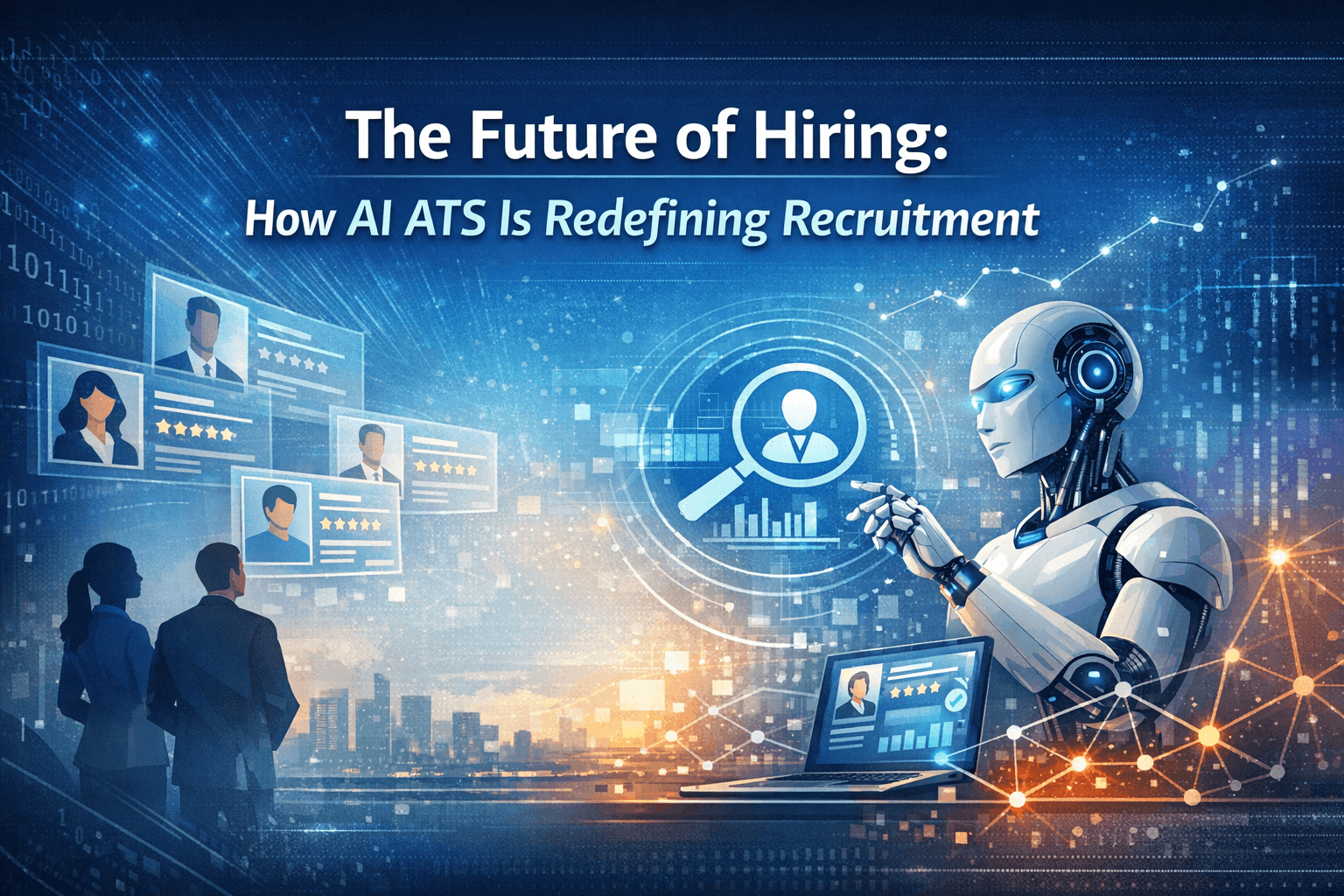
The Future of Hiring: How AI ATS Is Redefining Recruitment
Hiring has entered a critical inflection point.
Enterprises today are hiring at scale, across geographies, skills, and evolving job roles—yet many recruitment processes still rely on legacy ATS systems built for resume storage, not hiring intelligence.
This gap between modern hiring demands and outdated recruitment infrastructure is where AI ATS and AI recruitment platforms are reshaping the future of talent acquisition.
This article explores how AI ATS is redefining recruitment through industry trends, expert insights, and PeopleXM’s vision for ethical, skill-based, and data-driven hiring.
Industry Trends: Why AI ATS Is Becoming the New Hiring Standard
1. From Resume Management to Hiring Intelligence
Traditional ATS platforms were designed to track applications, not evaluate talent. In contrast, modern AI ATS systems focus on:
Understanding candidate skills, not just keywords
Mapping role requirements to real-world competencies
Supporting better hiring decisions, not just faster workflows
This shift reflects a broader trend: recruitment is becoming a decision science, not an administrative function.
2. Rise of AI Recruitment in High-Volume & Enterprise Hiring
Organizations hiring hundreds or thousands of candidates annually face challenges such as:
Recruiter burnout
Long time-to-hire
Inconsistent screening quality
High drop-off rates
AI recruitment platforms enable automated hiring workflows that scale intelligently—screening, shortlisting, and ranking candidates based on skills, role fit, and potential, while keeping humans in control of final decisions.
3. Skill-Based Hiring Replacing Credential-Based Filters
Degrees, job titles, and brand-name companies are no longer reliable indicators of performance.
Talent acquisition AI is increasingly used to:
Assess job-relevant skills
Identify adjacent or transferable capabilities
Reduce bias caused by resume formatting or background signals
This shift is critical for building diverse, future-ready workforces.
4. Ethics, Fairness, and Explainable AI in Hiring
As AI ATS adoption grows, enterprises are demanding:
Transparent screening logic
Bias-reduction mechanisms
Compliance with evolving AI governance norms
The future of AI recruitment is not “black-box automation” but explainable, auditable, and ethical AI hiring systems.
Expert POV: What the Future of AI ATS Really Looks Like
From an enterprise hiring perspective, the future of AI ATS is defined by augmentation, not replacement.
AI will not replace recruiters—but it will redefine their role.
What AI ATS Should Do Well
Automate repetitive, low-value tasks
Surface high-quality, role-relevant candidates
Provide hiring insights recruiters can trust
Improve consistency and fairness at scale
What AI ATS Should Never Do
Make final hiring decisions without human oversight
Optimize purely for speed at the cost of quality
Introduce hidden bias through opaque algorithms
The most effective AI recruitment platforms act as decision partners—supporting recruiters with data, context, and intelligence.
PeopleXM’s Vision: Responsible AI ATS for the Next Decade of Hiring
At PeopleXM, we believe the future of hiring is built on three core principles:
1. Intelligence Over Automation
Automated hiring should not mean blind automation.
PeopleXM’s AI ATS is designed to:
Understand skills semantically, not superficially
Align candidate capabilities with real job outcomes
Support recruiter judgment with explainable insights
2. Fairness by Design
Bias reduction cannot be an afterthought.
Our approach to AI recruitment emphasizes:
Skill-first evaluations
Reduced dependency on demographic proxies
Structured, consistent screening across candidates
This enables organizations to scale hiring without compromising fairness or diversity goals.
3. Enterprise-Grade Decision Intelligence
Modern hiring leaders need answers—not dashboards full of noise.
PeopleXM focuses on:
Quality of hire indicators
Funnel diagnostics
Talent intelligence that informs workforce planning
This positions AI ATS as a strategic hiring layer, not just a transactional tool.
The Road Ahead: What the Future of AI Recruitment Means for HR Leaders
Over the next few years, organizations that succeed in hiring will be those that:
Move from legacy ATS to AI-driven hiring platforms
Embrace skill-based, data-informed recruitment
Balance automation with accountability
Treat hiring as a long-term capability, not a short-term process
AI ATS will not just redefine recruitment—it will redefine how organizations build teams, careers, and competitive advantage.
FAQs: AI ATS & the Future of Recruitment
1. What is an AI ATS?
An AI ATS (Artificial Intelligence Applicant Tracking System) uses machine learning and intelligence models to enhance resume screening, candidate matching, and hiring decision support beyond traditional ATS capabilities.
2. How is AI recruitment different from traditional hiring?
AI recruitment focuses on skills, patterns, and data-driven insights, whereas traditional hiring relies heavily on manual screening, keywords, and subjective evaluation.
3. Is automated hiring safe and ethical?
Automated hiring is safe when designed with transparency, human oversight, and bias-reduction mechanisms. Ethical AI ATS platforms prioritize explainability and fairness.
4. Can AI ATS help improve quality of hire?
Yes. By focusing on role-relevant skills and structured evaluation, AI ATS platforms help organizations consistently identify candidates with higher long-term success potential.
5. Will AI replace recruiters in the future?
No. AI will augment recruiters by handling repetitive tasks and providing insights—allowing recruiters to focus on human judgment, relationship-building, and strategic hiring decisions.