August 2026 - People XM - Next Gen People Experience
;
31Aug

Candidate Experience & AI: How AI Is Transforming Recruitment | PeopleXM

Candidate Experience & AI: How Artificial Intelligence Is Transforming the Recruitment Journey

Recruitment is often viewed from the organization’s perspective.

How quickly can we fill the role?

How many applications did we receive?

How efficiently can recruiters screen candidates?

But there is another side of the hiring process that organizations cannot afford to ignore:

How does the candidate experience the journey?

For candidates, recruitment is not simply a process of submitting a resume and waiting for a response. It is their first meaningful interaction with an organization.

A slow application process, unclear communication, repeated follow-ups, or long periods without updates can create frustration—even when the company has a strong employer brand.

At the same time, recruitment teams are under pressure to manage growing application volumes with limited time.

This is where Artificial Intelligence can play an important role in improving candidate experience.

The purpose of AI in recruitment should not be to remove the human element.

Instead, it should help organizations eliminate unnecessary friction, improve communication, personalize interactions, and allow recruiters to spend more time where human engagement matters most.

What Is Candidate Experience?

Candidate experience refers to the overall perception and experience a job seeker has while interacting with an organization throughout the recruitment process.

This journey can include:

  • Discovering a job opportunity
  • Reading the job description
  • Completing an application
  • Receiving communication from the company
  • Participating in assessments
  • Attending interviews
  • Receiving updates
  • Receiving an offer—or rejection

Every interaction contributes to how candidates perceive the organization.

A candidate may not receive the job.

But they can still leave with a positive impression if the process is respectful, transparent, and well managed.

Why Candidate Experience Has Become a Recruitment Priority

Today’s candidates have more visibility into employers than ever before.

They research companies before applying. They read employee reviews. They talk to their professional networks. They share their experiences online.

This means recruitment is also part of employer branding.

A poor candidate experience can affect how people perceive an organization—even if they never become employees.

Common frustrations include:

  • Applications disappearing without acknowledgment
  • Long waiting periods without updates
  • Repeating the same information multiple times
  • Complex application processes
  • Unclear interview schedules
  • Lack of feedback
  • Poor communication after interviews

For recruitment teams handling hundreds or thousands of applications, solving these challenges manually can be difficult.

That is where AI-powered recruitment technology can help.

The Biggest Candidate Experience Problem: Recruitment Friction

Candidates rarely become frustrated because a company uses technology.

They become frustrated when technology creates unnecessary barriers.

For example:

❌ A candidate spends 30 minutes filling out information already available in their resume.

❌ They receive no confirmation after applying.

❌ They don’t know what happens next.

❌ An interview is scheduled and then repeatedly rescheduled.

❌ They complete an assessment without understanding the process.

❌ They wait weeks without receiving an update.

These problems are not always caused by recruiters.

Often, they are caused by fragmented recruitment processes.

AI and automation can help create a more connected and responsive experience.

How AI Can Improve Candidate Experience

1. Faster Application Processing

Candidates want to know that their application has been received and considered.

AI-assisted recruitment systems can help organizations process large volumes of applications more efficiently.

Instead of applications sitting untouched because recruiters are manually reviewing thousands of resumes, AI can support initial screening and candidate prioritization.

This can help reduce unnecessary delays.

The benefit for candidates:

A faster and more responsive hiring journey.

2. Personalized Candidate Communication

One of the most important aspects of candidate experience is communication.

Candidates want clarity about:

  • Whether their application was received
  • What happens next
  • Whether they need to complete an assessment
  • When an interview will take place
  • Where they are in the recruitment process

AI and automation can help organizations deliver timely updates at different stages of the hiring journey.

This doesn’t mean every interaction should be automated.

Instead, routine updates can be automated while recruiters focus on conversations that require empathy, judgment, and personal engagement.

3. Smarter Job and Candidate Matching

Traditional recruitment systems often rely heavily on exact keywords.

But candidates may describe their experience differently from the language used in a job description.

AI-powered matching can help evaluate broader relevance by considering factors such as:

  • Skills
  • Experience
  • Role requirements
  • Related competencies
  • Career progression

This can create a more meaningful connection between candidates and relevant opportunities.

The goal is not simply to process resumes faster.

It is to help candidates be considered for opportunities that genuinely match their capabilities.

4. Reducing Repetitive Application Processes

One of the most frustrating experiences for job seekers is uploading a resume and then manually entering the same information again.

Modern recruitment platforms can help reduce this friction through better data extraction and application workflows.

A smoother application process demonstrates respect for the candidate’s time.

This is a simple but important part of candidate experience.

5. Better Interview Scheduling

Scheduling interviews can involve multiple emails between candidates, recruiters, and hiring managers.

For high-volume recruitment, this can quickly become complicated.

AI-enabled scheduling and workflow automation can help coordinate:

  • Available time slots
  • Candidate preferences
  • Interviewer availability
  • Interview reminders
  • Rescheduling

The result is a smoother experience for everyone involved.

6. AI-Powered Assessments with Meaningful Insights

Candidates increasingly participate in assessments during recruitment.

But assessments can create a poor experience if they feel irrelevant, excessively long, or disconnected from the role.

A better approach is to use role-relevant skill assessments.

AI-powered assessment platforms can help organizations align assessments more closely with the skills required for a specific position.

This creates a more meaningful experience for candidates while helping recruiters evaluate capabilities beyond the resume.

7. Faster Feedback and Status Updates

One of the most common complaints from candidates is:

“I never heard back.”

Not every organization can provide detailed personalized feedback to thousands of applicants.

However, technology can help organizations provide better communication and clearer status updates.

Candidates should ideally understand whether they are:

  • Under review
  • Moving to the next stage
  • Required to complete an assessment
  • Scheduled for an interview
  • No longer being considered

Transparency can significantly improve how candidates perceive the hiring process.

AI Should Make Recruitment More Human—Not Less Human

There is a common misconception that AI automatically makes recruitment impersonal.

The opposite can be true when AI is implemented thoughtfully.

Consider how recruiters spend their time.

Without automation, they may spend hours:

  • Sorting resumes
  • Updating spreadsheets
  • Sending repetitive emails
  • Coordinating schedules
  • Tracking candidate status

With AI and automation supporting these tasks, recruiters can spend more time on:

  • Meaningful candidate conversations
  • Understanding individual circumstances
  • Building relationships
  • Supporting hiring managers
  • Improving candidate engagement

The best use of AI is not replacing human interaction.

It is removing repetitive work that prevents human interaction from happening.

The AI + Human Recruitment Model

The future of candidate experience is unlikely to be completely automated.

Instead, successful organizations will build a balanced model.

AI Supports:

  • Resume screening
  • Candidate matching
  • Workflow automation
  • Communication triggers
  • Interview scheduling
  • Assessment management
  • Recruitment analytics

Humans Lead:

  • Relationship building
  • Complex conversations
  • Interviews
  • Contextual decision-making
  • Candidate support
  • Final hiring decisions

This creates a recruitment model where technology improves efficiency while people provide empathy and judgment.

Personalization Without Losing Privacy

Personalization can improve candidate experience, but organizations must use candidate data responsibly.

AI-powered recruitment systems should be designed with attention to:

  • Data privacy
  • Transparency
  • Responsible data usage
  • Appropriate human oversight
  • Fair evaluation processes

Candidates should not feel that they are being evaluated by an invisible system they cannot understand.

Responsible AI means organizations should think carefully about how technology is used and where human review is necessary.

AI and Fairness in Candidate Experience

Consistency is another important aspect of candidate experience.

In manual recruitment processes, different candidates may receive different levels of communication or evaluation depending on workload and individual processes.

Technology can help standardize workflows.

For example:

  • Candidates receive consistent process information
  • Assessments are administered using defined criteria
  • Applications follow structured workflows
  • Recruiters have better visibility into candidate progress

However, AI is not automatically bias-free.

Organizations should regularly review how AI tools are used and ensure that technology supports fair and relevant evaluation.

The objective should be:

More consistent processes, greater transparency, and appropriate human oversight.

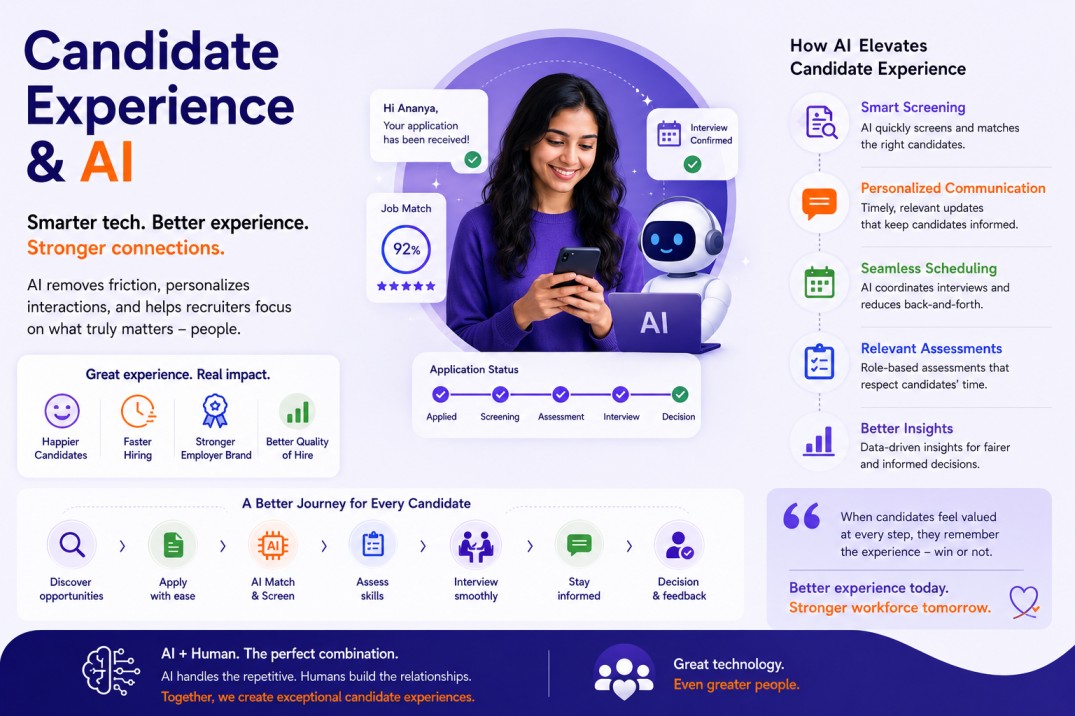
Candidate Experience Across the Recruitment Journey

Let’s look at how AI can support different stages.

Stage 1: Job Discovery

AI can help connect candidates with relevant opportunities based on skills and experience.

Candidate benefit:

More relevant opportunities.

Stage 2: Application

Better workflows can reduce repetitive forms and unnecessary friction.

Candidate benefit:

A faster and easier application process.

Stage 3: Screening

AI-assisted systems can help recruiters process applications efficiently.

Candidate benefit:

Reduced waiting time.

Stage 4: Assessment

Role-based assessments can evaluate relevant capabilities.

Candidate benefit:

A clearer and more meaningful evaluation process.

Stage 5: Interview

Scheduling automation and structured workflows can simplify coordination.

Candidate benefit:

Better communication and fewer delays.

Stage 6: Decision and Communication

Automated workflows can help ensure candidates receive timely updates.

Candidate benefit:

Greater transparency.

How PeopleXM Supports a Better Candidate Experience

PeopleXM is designed around the idea that modern recruitment should be both efficient for recruiters and meaningful for candidates.

An AI-powered hiring platform can help bring different parts of the recruitment journey together, including:

  • AI-assisted resume screening
  • JD-based candidate matching
  • Smart skill assessments
  • Candidate workflow management
  • Automated recruitment processes
  • Interview coordination
  • Candidate insights
  • Talent rediscovery

The objective is not simply to automate recruitment.

It is to reduce unnecessary friction throughout the hiring journey.

When recruiters have better tools and clearer candidate insights, they can focus more attention on meaningful hiring interactions.

Measuring Candidate Experience

Organizations should not rely only on assumptions.

Candidate experience can be measured through indicators such as:

Application Completion Rate

How many candidates successfully complete the application process?

A low completion rate may indicate unnecessary complexity.

Candidate Drop-Off Rate

At which stage are candidates leaving the recruitment process?

This can reveal friction in applications, assessments, or interview workflows.

Time Between Hiring Stages

How long are candidates waiting for updates?

Long delays can negatively affect the candidate experience.

Interview Scheduling Time

How efficiently are interviews being coordinated?

Candidate Feedback

What do candidates say about their experience?

Surveys and feedback can provide valuable insights that recruitment analytics alone cannot.

Common Mistakes When Using AI for Candidate Experience

AI can improve recruitment, but implementation matters.

Here are some common mistakes organizations should avoid.

1. Automating Everything

Not every candidate interaction should be automated.

Sensitive conversations and important decisions require human involvement.

2. Using Generic Communication

Automation should not result in confusing or irrelevant messages.

Communication should be clear and relevant to the candidate’s stage.

3. Creating Complex Assessments

Technology should simplify evaluation—not create unnecessary barriers.

Assessments should be relevant to the role and respectful of candidates’ time.

4. Removing Human Oversight

AI should support recruiters, not become an unquestioned decision-maker.

Human review remains essential.

5. Ignoring Candidate Feedback

Technology provides data, but candidates provide context.

Organizations should continuously listen to candidate feedback and improve their processes.

The Future of Candidate Experience and AI

The future of recruitment will likely become more personalized, responsive, and data-informed.

Candidates will increasingly expect:

  • Faster responses
  • Relevant opportunities
  • Clear communication
  • Flexible interview experiences
  • Personalized interactions
  • Transparent processes

AI can help organizations meet these expectations at scale.

But the organizations that succeed won’t necessarily be the ones using the most automation.

They will be the ones using technology thoughtfully.

The future belongs to recruitment teams that understand a simple principle:

Efficiency and empathy do not have to compete.

With the right technology, organizations can build hiring processes that are faster for recruiters and better for candidates.

Conclusion: Better Technology Can Create Better Human Experiences

Candidate experience is no longer a secondary part of recruitment.

It is part of employer branding, talent attraction, and long-term business reputation.

AI offers an opportunity to improve recruitment by reducing delays, simplifying workflows, personalizing communication, and helping recruiters focus on meaningful interactions.

But AI should never remove the human side of hiring.

Its greatest value comes from helping people do what technology cannot:

Listen. Understand. Connect. And make thoughtful decisions.

A strong candidate experience combines the efficiency of AI with the empathy of human recruiters.

That is the direction modern recruitment is moving toward—and platforms like PeopleXM can help organizations build a smarter, more connected, and candidate-friendly hiring journey.
26Aug

High-Volume Hiring ATS: How AI-Powered Recruitment Systems Help Teams Hire Faster and Better

High-Volume Hiring ATS: How AI Is Changing Recruitment at Scale

Hiring a few candidates is one thing.

Hiring hundreds or thousands of candidates for multiple roles at the same time is an entirely different challenge.

Recruiters handling high-volume hiring often deal with thousands of resumes, multiple job descriptions, repetitive screening, candidate communication, assessments, interview scheduling, and constant coordination with hiring managers.

When these processes depend heavily on spreadsheets, emails, manual resume reviews, and disconnected recruitment tools, the workload can quickly become overwhelming.

This is where a High-Volume Hiring ATS can make a significant difference.

A modern Applicant Tracking System designed for high-volume recruitment does more than store resumes. It helps organizations organize applicants, automate repetitive work, identify relevant skills, evaluate candidates consistently, and give recruiters better visibility across the hiring pipeline.

For organizations hiring at scale, the goal isn’t simply to process more applications.

It’s to make better hiring decisions without allowing volume to compromise quality.

What Is a High-Volume Hiring ATS?

A High-Volume Hiring ATS is an Applicant Tracking System designed specifically to manage large numbers of candidates and recruitment activities efficiently.

A traditional ATS may primarily focus on storing applications and tracking candidates through different hiring stages.

A high-volume recruitment ATS goes further by helping recruiters manage:

  • Large candidate databases
  • Multiple job openings
  • Bulk resume uploads
  • Automated resume screening
  • Job-description-based candidate matching
  • Skill assessments
  • Candidate communication
  • Interview workflows
  • Recruiter collaboration
  • Hiring analytics
  • Candidate rediscovery

The key difference is scale and automation.

Instead of asking recruiters to manually process every candidate, the system helps prioritize where human attention is most valuable.

Why High-Volume Hiring Is Difficult

High-volume hiring isn’t simply “normal hiring with more candidates.”

The increase in application volume creates operational challenges at almost every stage of recruitment.

1. Thousands of Resumes Create a Screening Bottleneck

When a role attracts hundreds or thousands of applications, manually reviewing every resume becomes difficult.

Recruiters may spend significant time looking for:

  • Relevant experience
  • Required skills
  • Educational qualifications
  • Certifications
  • Industry exposure
  • Role-specific competencies

The challenge becomes even greater when recruiters are simultaneously managing multiple positions.

2. Recruiters Can Spend Too Much Time on Repetitive Tasks

Recruitment involves many administrative activities:

  • Resume sorting
  • Candidate data entry
  • Shortlisting
  • Assessment assignment
  • Interview coordination
  • Status updates
  • Candidate follow-ups
  • Reporting

When these activities are performed manually, recruiters have less time for activities that require human judgment.

A good recruitment system should therefore automate processes, not replace people.

3. Job Descriptions Don’t Always Translate Into Effective Screening

A job description may contain dozens of requirements, but recruiters still need to determine which candidates actually match the role.

For example, consider a software engineering position requiring:

  • Python
  • SQL
  • Data structures
  • APIs
  • Cloud experience
  • Problem-solving

A resume may contain related terminology without demonstrating the required level of competency.

This is where skill-based candidate evaluation becomes important.

4. High Application Volume Can Affect Candidate Experience

Candidates don’t see the recruiter’s workload.

They see the hiring process.

If applications remain unanswered, interview processes are delayed, or candidates receive inconsistent communication, the employer brand can suffer.

An efficient ATS can help organizations create a more organized candidate journey while allowing recruiters to manage large applicant volumes.

What Should a High-Volume Hiring ATS Do?

A high-volume ATS should help recruiters move from manual processing to intelligent prioritization.

Here are the capabilities organizations should look for.

1. Automated Resume Screening

One of the biggest advantages of an AI-enabled ATS is the ability to process large volumes of resumes quickly.

Instead of reviewing every resume manually from the beginning, recruiters can use AI to identify candidates whose profiles are more closely aligned with the requirements of the role.

The system can evaluate information such as:

  • Skills
  • Experience
  • Education
  • Certifications
  • Role relevance
  • Industry exposure

This allows recruiters to focus their time on candidates who require deeper evaluation.

The goal isn’t to eliminate human screening.

The goal is to reduce the amount of repetitive screening humans need to perform.

2. Job Description-Based Candidate Matching

A strong high-volume ATS should understand the relationship between a job description and a candidate profile.

Instead of relying exclusively on exact keyword matches, modern recruitment platforms can evaluate broader skill and experience relevance.

For example:

Job Requirement:
“Experience building REST APIs using Python.”

A candidate may describe their experience using different terminology.

A more intelligent matching system can look beyond exact wording and assess whether the candidate’s skills and experience are relevant to the requirement.

This is particularly useful when application volumes are high.

3. Bulk Resume Processing

High-volume recruitment often means handling large candidate databases.

Recruiters should be able to upload or import candidates in bulk rather than processing profiles individually.

This can significantly simplify workflows for:

  • Campus recruitment
  • BPO and customer support hiring
  • Sales recruitment
  • Retail hiring
  • Staffing organizations
  • Seasonal hiring
  • Graduate recruitment
  • Enterprise recruitment campaigns
 4. Skill-Based Assessments

A resume can tell recruiters what a candidate has done.

It doesn’t always tell them what the candidate can actually do.

Skill assessments add another layer of evaluation.

A high-volume ATS can help recruiters assess candidates against role-specific competencies before moving them further through the hiring process.

This creates a more structured evaluation process:

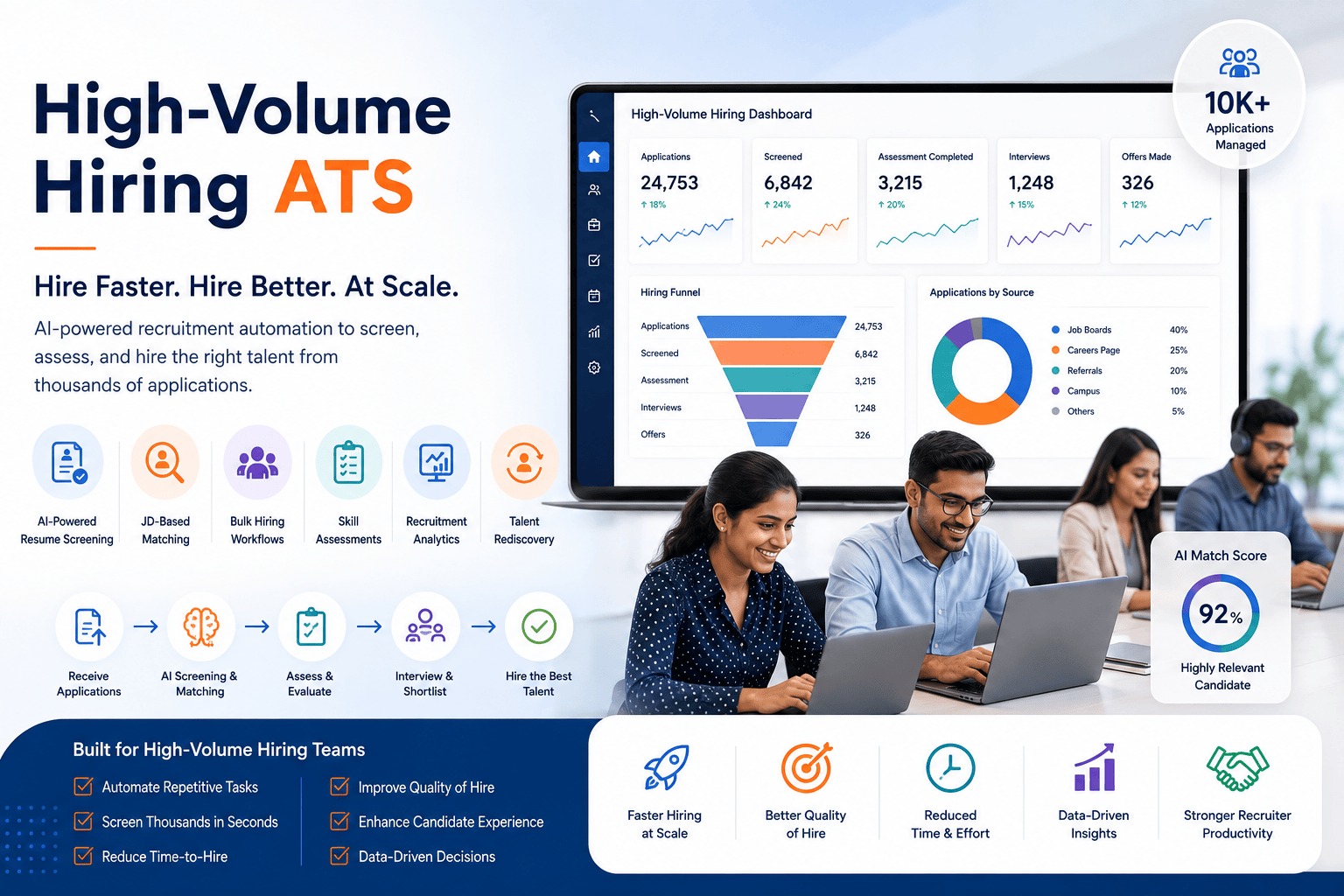
Resume → Skill Match → Assessment → Interview → Hiring Decision

The exact workflow can vary by organization, but the principle remains the same:

Evaluate candidates against the requirements of the role, not just the volume of applications.

5. Automated Candidate Prioritization

Not every applicant needs the same level of recruiter attention at the same stage.

An intelligent ATS can help recruiters prioritize candidates based on factors such as:

  • Role fit
  • Relevant skills
  • Assessment performance
  • Experience
  • Job requirements
  • Candidate status

This allows recruiters to create a more focused hiring funnel.

Instead of starting with:

2,000 applications → manually review 2,000 resumes

the process can become:

2,000 applications → AI-assisted screening → prioritized candidates → deeper human evaluation

The recruiter remains responsible for the final decision.

6. Candidate Rediscovery

Organizations often have valuable candidates sitting inside their existing talent databases.

A candidate who wasn’t suitable for one position may be an excellent fit for another.

A modern ATS should therefore make candidate rediscovery easier.

Instead of starting from zero whenever a new position opens, recruiters can search their existing talent pool for candidates whose skills and experience match the new requirement.

This turns an existing database into a reusable talent asset.

7. Automated Assessments and Interview Workflows

High-volume hiring requires consistency.

Recruiters may need to assess hundreds of candidates using the same evaluation criteria.

An ATS integrated with assessments and interview workflows can help standardize these processes.

For example:

Application received

Resume screened

Candidate matched to role

Assessment assigned

Assessment evaluated

Interview scheduled

Recruiter review

Hiring decision

This reduces unnecessary manual coordination.

8. Recruitment Analytics

When hiring at scale, recruiters need visibility.

A modern ATS should help answer questions such as:

  • How many candidates applied?
  • How many passed screening?
  • Which sources generate the best candidates?
  • Where are candidates dropping out?
  • How long does each hiring stage take?
  • Which roles are difficult to fill?
  • How many candidates are assessment-ready?
  • What is the conversion rate between hiring stages?

These insights allow recruitment teams to identify bottlenecks instead of relying on assumptions.

AI ATS vs Traditional ATS for High-Volume Hiring

Capability Traditional ATS AI-Powered High-Volume ATS
Candidate tracking
Resume storage
Automated screening Limited
Skill-based matching Limited
Bulk candidate processing
Candidate prioritization Limited
Skill assessments Often separate Integrated/connected
Candidate rediscovery Basic AI-assisted
Hiring analytics Basic Advanced
Workflow automation
Decision support Limited AI-assisted

The important point is that an AI-powered ATS shouldn’t simply add AI for the sake of it.

AI should make the recruitment process more useful, explainable, and efficient.

How a High-Volume Hiring ATS Changes the Recruiter’s Day

Consider a recruiter hiring 100 customer support representatives.

Without an optimized workflow

The recruiter may need to:

  1. Download applications
  2. Open resumes individually
  3. Check qualifications
  4. Create a shortlist
  5. Contact candidates
  6. Assign assessments
  7. Track assessment results
  8. Schedule interviews
  9. Update spreadsheets
  10. Prepare reports

Now multiply this process across several open positions.

The administrative workload can quickly become the bottleneck.

With an AI-powered recruitment workflow

The recruiter can:

  1. Create the job requirement
  2. Receive applications centrally
  3. Use AI-assisted matching and screening
  4. Prioritize relevant candidates
  5. Assign assessments
  6. Review candidate insights
  7. Conduct interviews
  8. Make the final hiring decision
  9. Track the complete recruitment funnel

The difference isn’t simply speed.

It’s where recruiters spend their time.

High-Volume Hiring Shouldn’t Mean Low-Quality Hiring

One of the biggest misconceptions about high-volume recruitment is that organizations must choose between speed and quality.

They don’t have to.

The right technology can help recruiters handle large candidate volumes while introducing more structured evaluation.

A strong high-volume hiring strategy combines:

Automation

For repetitive administrative tasks.

AI

For screening, matching, prioritization, and decision support.

Assessments

For evaluating relevant skills.

Human judgment

For interviews, context, culture, and final hiring decisions.

This creates a human + AI recruitment model rather than a fully automated hiring model.

The Role of Responsible AI in High-Volume Recruitment

More automation means more responsibility.

When AI is used to screen or prioritize candidates, organizations should consider:

  • What information is being evaluated?
  • Are job requirements clearly defined?
  • Can recruiters understand why candidates are being prioritized?
  • Are irrelevant characteristics influencing recommendations?
  • Is there appropriate human oversight?
  • Are evaluation criteria consistent across candidates?

AI should support fairer and more consistent recruitment—not create another layer of hidden bias.

For this reason, organizations should evaluate not only what an AI ATS can automate, but also how responsibly it makes recommendations.

How PeopleXM Approaches High-Volume Hiring

PeopleXM is designed to help organizations move beyond basic applicant tracking toward AI-assisted, skill-focused recruitment.

For high-volume hiring teams, the platform can bring together capabilities such as:

  • AI-assisted resume screening
  • JD-based candidate matching
  • Smart skill assessments
  • Automated assessment workflows
  • Candidate prioritization
  • Talent rediscovery
  • Psychometric insights
  • Proctoring and assessment integrity
  • Recruitment analytics

The underlying objective is simple:

Help recruiters spend less time processing applications and more time evaluating the right candidates.

Rather than treating every resume equally, PeopleXM helps recruitment teams introduce greater structure into the hiring funnel.

How to Choose the Right High-Volume Hiring ATS

Before selecting an ATS, recruitment leaders should evaluate it against the organization’s actual hiring workflow.

Ask these questions:

Can it handle large candidate volumes?

The system should remain practical when application numbers increase significantly.

Can it match candidates to specific job requirements?

Look for skill- and role-based matching rather than relying entirely on keywords.

Can it automate repetitive workflows?

Automation should reduce administrative work without removing necessary human oversight.

Can it evaluate skills?

Resume matching alone isn’t enough for many roles. Assessments can provide additional evidence of candidate capability.

Can recruiters access meaningful analytics?

Recruitment teams need actionable insights, not just dashboards filled with numbers.

Can it integrate with existing systems?

An ATS should fit into the broader HR technology ecosystem rather than creating another isolated database.

Does it support responsible AI practices?

Organizations should understand how AI recommendations are generated and where human decision-making remains necessary.

Metrics That Matter in High-Volume Hiring

The success of a high-volume hiring ATS shouldn’t be measured only by the number of applications processed.

Recruitment leaders should monitor metrics such as:

Time to Screen

How quickly can applications move through initial screening?

Time to Hire

How long does it take to move a suitable candidate from application to offer?

Screening-to-Interview Ratio

How efficiently does screening identify candidates worth interviewing?

Assessment Completion Rate

How many candidates complete required assessments?

Interview-to-Offer Ratio

How effectively does the interview stage identify suitable candidates?

Quality of Hire

Do selected candidates actually perform well after joining?

Candidate Drop-Off

At which stage are candidates leaving the recruitment process?

Recruiter Productivity

How much time are recruiters spending on administrative work versus high-value candidate evaluation?

These metrics provide a more complete picture of recruitment effectiveness.

The Future of High-Volume Recruitment

High-volume hiring is moving toward a model where technology handles more of the repetitive work while recruiters focus on judgment and relationships.

The future recruitment workflow is likely to be increasingly:

Skill-focused

Data-informed

AI-assisted

Human-led

This doesn’t mean recruiters become less important.

It means their role becomes more strategic.

Instead of spending hours searching through resumes, recruiters can spend more time understanding candidates, engaging talent, partnering with hiring managers, and improving the overall hiring experience.

Conclusion: Scale Hiring Without Losing the Human Element

High-volume recruitment presents a fundamental challenge:

How do you evaluate more candidates without compromising speed, quality, or candidate experience?

A modern High-Volume Hiring ATS can help answer that question.

By combining automated workflows, AI-assisted screening, job-based matching, skill assessments, candidate rediscovery, and recruitment analytics, organizations can create a more structured and scalable hiring process.

But technology alone isn’t the answer.

The strongest recruitment strategies combine AI efficiency with human judgment.

For organizations hiring hundreds or thousands of candidates, the goal shouldn’t be to automate hiring completely.

It should be to automate the repetitive work, improve the quality of information available to recruiters, and give human decision-makers more time to make better hiring decisions.

That’s where an AI-first platform like PeopleXM can become part of a modern high-volume talent acquisition strategy.


;