
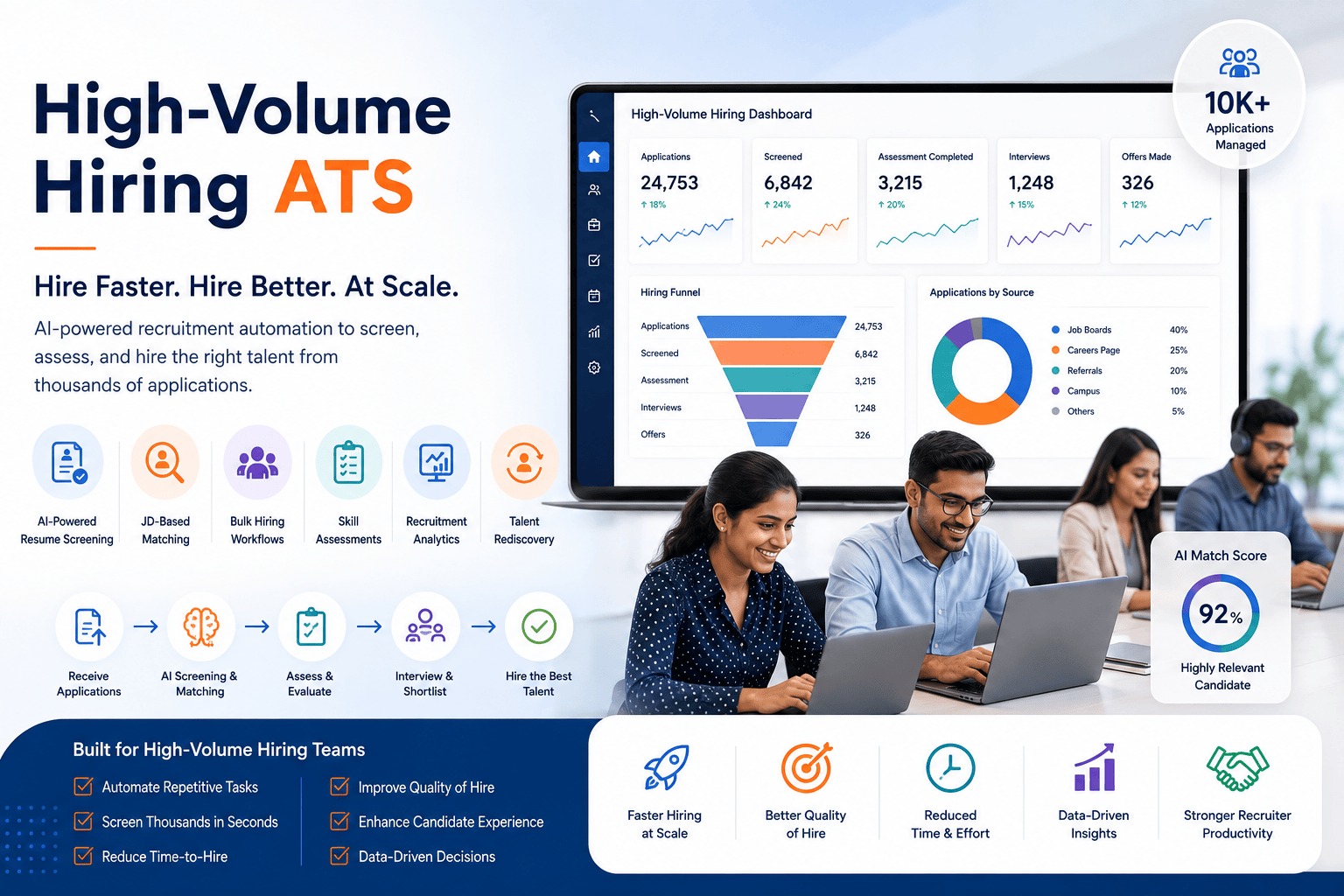
High-Volume Hiring ATS: How AI Is Changing Recruitment at Scale
Hiring a few candidates is one thing.
Hiring hundreds or thousands of candidates for multiple roles at the same time is an entirely different challenge.
Recruiters handling high-volume hiring often deal with thousands of resumes, multiple job descriptions, repetitive screening, candidate communication, assessments, interview scheduling, and constant coordination with hiring managers.
When these processes depend heavily on spreadsheets, emails, manual resume reviews, and disconnected recruitment tools, the workload can quickly become overwhelming.
This is where a High-Volume Hiring ATS can make a significant difference.
A modern Applicant Tracking System designed for high-volume recruitment does more than store resumes. It helps organizations organize applicants, automate repetitive work, identify relevant skills, evaluate candidates consistently, and give recruiters better visibility across the hiring pipeline.
For organizations hiring at scale, the goal isn’t simply to process more applications.
It’s to make better hiring decisions without allowing volume to compromise quality.
What Is a High-Volume Hiring ATS?
A High-Volume Hiring ATS is an Applicant Tracking System designed specifically to manage large numbers of candidates and recruitment activities efficiently.
A traditional ATS may primarily focus on storing applications and tracking candidates through different hiring stages.
A high-volume recruitment ATS goes further by helping recruiters manage:
- Large candidate databases
- Multiple job openings
- Bulk resume uploads
- Automated resume screening
- Job-description-based candidate matching
- Skill assessments
- Candidate communication
- Interview workflows
- Recruiter collaboration
- Hiring analytics
- Candidate rediscovery
The key difference is scale and automation.
Instead of asking recruiters to manually process every candidate, the system helps prioritize where human attention is most valuable.
Why High-Volume Hiring Is Difficult
High-volume hiring isn’t simply “normal hiring with more candidates.”
The increase in application volume creates operational challenges at almost every stage of recruitment.
1. Thousands of Resumes Create a Screening Bottleneck
When a role attracts hundreds or thousands of applications, manually reviewing every resume becomes difficult.
Recruiters may spend significant time looking for:
- Relevant experience
- Required skills
- Educational qualifications
- Certifications
- Industry exposure
- Role-specific competencies
The challenge becomes even greater when recruiters are simultaneously managing multiple positions.
2. Recruiters Can Spend Too Much Time on Repetitive Tasks
Recruitment involves many administrative activities:
- Resume sorting
- Candidate data entry
- Shortlisting
- Assessment assignment
- Interview coordination
- Status updates
- Candidate follow-ups
- Reporting
When these activities are performed manually, recruiters have less time for activities that require human judgment.
A good recruitment system should therefore automate processes, not replace people.
3. Job Descriptions Don’t Always Translate Into Effective Screening
A job description may contain dozens of requirements, but recruiters still need to determine which candidates actually match the role.
For example, consider a software engineering position requiring:
- Python
- SQL
- Data structures
- APIs
- Cloud experience
- Problem-solving
A resume may contain related terminology without demonstrating the required level of competency.
This is where skill-based candidate evaluation becomes important.
4. High Application Volume Can Affect Candidate Experience
Candidates don’t see the recruiter’s workload.
They see the hiring process.
If applications remain unanswered, interview processes are delayed, or candidates receive inconsistent communication, the employer brand can suffer.
An efficient ATS can help organizations create a more organized candidate journey while allowing recruiters to manage large applicant volumes.
What Should a High-Volume Hiring ATS Do?
A high-volume ATS should help recruiters move from manual processing to intelligent prioritization.
Here are the capabilities organizations should look for.
1. Automated Resume Screening
One of the biggest advantages of an AI-enabled ATS is the ability to process large volumes of resumes quickly.
Instead of reviewing every resume manually from the beginning, recruiters can use AI to identify candidates whose profiles are more closely aligned with the requirements of the role.
The system can evaluate information such as:
- Skills
- Experience
- Education
- Certifications
- Role relevance
- Industry exposure
This allows recruiters to focus their time on candidates who require deeper evaluation.
The goal isn’t to eliminate human screening.
The goal is to reduce the amount of repetitive screening humans need to perform.
2. Job Description-Based Candidate Matching
A strong high-volume ATS should understand the relationship between a job description and a candidate profile.
Instead of relying exclusively on exact keyword matches, modern recruitment platforms can evaluate broader skill and experience relevance.
For example:
Job Requirement:
“Experience building REST APIs using Python.”
A candidate may describe their experience using different terminology.
A more intelligent matching system can look beyond exact wording and assess whether the candidate’s skills and experience are relevant to the requirement.
This is particularly useful when application volumes are high.
3. Bulk Resume Processing
High-volume recruitment often means handling large candidate databases.
Recruiters should be able to upload or import candidates in bulk rather than processing profiles individually.
This can significantly simplify workflows for:
- Campus recruitment
- BPO and customer support hiring
- Sales recruitment
- Retail hiring
- Staffing organizations
- Seasonal hiring
- Graduate recruitment
- Enterprise recruitment campaigns
A resume can tell recruiters what a candidate has done.
It doesn’t always tell them what the candidate can actually do.
Skill assessments add another layer of evaluation.
A high-volume ATS can help recruiters assess candidates against role-specific competencies before moving them further through the hiring process.
This creates a more structured evaluation process:
Resume → Skill Match → Assessment → Interview → Hiring Decision
The exact workflow can vary by organization, but the principle remains the same:
Evaluate candidates against the requirements of the role, not just the volume of applications.
5. Automated Candidate Prioritization
Not every applicant needs the same level of recruiter attention at the same stage.
An intelligent ATS can help recruiters prioritize candidates based on factors such as:
- Role fit
- Relevant skills
- Assessment performance
- Experience
- Job requirements
- Candidate status
This allows recruiters to create a more focused hiring funnel.
Instead of starting with:
2,000 applications → manually review 2,000 resumes
the process can become:
2,000 applications → AI-assisted screening → prioritized candidates → deeper human evaluation
The recruiter remains responsible for the final decision.
6. Candidate Rediscovery
Organizations often have valuable candidates sitting inside their existing talent databases.
A candidate who wasn’t suitable for one position may be an excellent fit for another.
A modern ATS should therefore make candidate rediscovery easier.
Instead of starting from zero whenever a new position opens, recruiters can search their existing talent pool for candidates whose skills and experience match the new requirement.
This turns an existing database into a reusable talent asset.
7. Automated Assessments and Interview Workflows
High-volume hiring requires consistency.
Recruiters may need to assess hundreds of candidates using the same evaluation criteria.
An ATS integrated with assessments and interview workflows can help standardize these processes.
For example:
Application received
↓
Resume screened
↓
Candidate matched to role
↓
Assessment assigned
↓
Assessment evaluated
↓
Interview scheduled
↓
Recruiter review
↓
Hiring decision
This reduces unnecessary manual coordination.
8. Recruitment Analytics
When hiring at scale, recruiters need visibility.
A modern ATS should help answer questions such as:
- How many candidates applied?
- How many passed screening?
- Which sources generate the best candidates?
- Where are candidates dropping out?
- How long does each hiring stage take?
- Which roles are difficult to fill?
- How many candidates are assessment-ready?
- What is the conversion rate between hiring stages?
These insights allow recruitment teams to identify bottlenecks instead of relying on assumptions.
AI ATS vs Traditional ATS for High-Volume Hiring
| Capability | Traditional ATS | AI-Powered High-Volume ATS |
|---|---|---|
| Candidate tracking | ✓ | ✓ |
| Resume storage | ✓ | ✓ |
| Automated screening | Limited | ✓ |
| Skill-based matching | Limited | ✓ |
| Bulk candidate processing | ✓ | ✓ |
| Candidate prioritization | Limited | ✓ |
| Skill assessments | Often separate | Integrated/connected |
| Candidate rediscovery | Basic | AI-assisted |
| Hiring analytics | Basic | Advanced |
| Workflow automation | ✓ | ✓ |
| Decision support | Limited | AI-assisted |
The important point is that an AI-powered ATS shouldn’t simply add AI for the sake of it.
AI should make the recruitment process more useful, explainable, and efficient.
How a High-Volume Hiring ATS Changes the Recruiter’s Day
Consider a recruiter hiring 100 customer support representatives.
Without an optimized workflow
The recruiter may need to:
- Download applications
- Open resumes individually
- Check qualifications
- Create a shortlist
- Contact candidates
- Assign assessments
- Track assessment results
- Schedule interviews
- Update spreadsheets
- Prepare reports
Now multiply this process across several open positions.
The administrative workload can quickly become the bottleneck.
With an AI-powered recruitment workflow
The recruiter can:
- Create the job requirement
- Receive applications centrally
- Use AI-assisted matching and screening
- Prioritize relevant candidates
- Assign assessments
- Review candidate insights
- Conduct interviews
- Make the final hiring decision
- Track the complete recruitment funnel
The difference isn’t simply speed.
It’s where recruiters spend their time.
High-Volume Hiring Shouldn’t Mean Low-Quality Hiring
One of the biggest misconceptions about high-volume recruitment is that organizations must choose between speed and quality.
They don’t have to.
The right technology can help recruiters handle large candidate volumes while introducing more structured evaluation.
A strong high-volume hiring strategy combines:
Automation
For repetitive administrative tasks.
AI
For screening, matching, prioritization, and decision support.
Assessments
For evaluating relevant skills.
Human judgment
For interviews, context, culture, and final hiring decisions.
This creates a human + AI recruitment model rather than a fully automated hiring model.
The Role of Responsible AI in High-Volume Recruitment
More automation means more responsibility.
When AI is used to screen or prioritize candidates, organizations should consider:
- What information is being evaluated?
- Are job requirements clearly defined?
- Can recruiters understand why candidates are being prioritized?
- Are irrelevant characteristics influencing recommendations?
- Is there appropriate human oversight?
- Are evaluation criteria consistent across candidates?
AI should support fairer and more consistent recruitment—not create another layer of hidden bias.
For this reason, organizations should evaluate not only what an AI ATS can automate, but also how responsibly it makes recommendations.
How PeopleXM Approaches High-Volume Hiring
PeopleXM is designed to help organizations move beyond basic applicant tracking toward AI-assisted, skill-focused recruitment.
For high-volume hiring teams, the platform can bring together capabilities such as:
- AI-assisted resume screening
- JD-based candidate matching
- Smart skill assessments
- Automated assessment workflows
- Candidate prioritization
- Talent rediscovery
- Psychometric insights
- Proctoring and assessment integrity
- Recruitment analytics
The underlying objective is simple:
Help recruiters spend less time processing applications and more time evaluating the right candidates.
Rather than treating every resume equally, PeopleXM helps recruitment teams introduce greater structure into the hiring funnel.
How to Choose the Right High-Volume Hiring ATS
Before selecting an ATS, recruitment leaders should evaluate it against the organization’s actual hiring workflow.
Ask these questions:
Can it handle large candidate volumes?
The system should remain practical when application numbers increase significantly.
Can it match candidates to specific job requirements?
Look for skill- and role-based matching rather than relying entirely on keywords.
Can it automate repetitive workflows?
Automation should reduce administrative work without removing necessary human oversight.
Can it evaluate skills?
Resume matching alone isn’t enough for many roles. Assessments can provide additional evidence of candidate capability.
Can recruiters access meaningful analytics?
Recruitment teams need actionable insights, not just dashboards filled with numbers.
Can it integrate with existing systems?
An ATS should fit into the broader HR technology ecosystem rather than creating another isolated database.
Does it support responsible AI practices?
Organizations should understand how AI recommendations are generated and where human decision-making remains necessary.
Metrics That Matter in High-Volume Hiring
The success of a high-volume hiring ATS shouldn’t be measured only by the number of applications processed.
Recruitment leaders should monitor metrics such as:
Time to Screen
How quickly can applications move through initial screening?
Time to Hire
How long does it take to move a suitable candidate from application to offer?
Screening-to-Interview Ratio
How efficiently does screening identify candidates worth interviewing?
Assessment Completion Rate
How many candidates complete required assessments?
Interview-to-Offer Ratio
How effectively does the interview stage identify suitable candidates?
Quality of Hire
Do selected candidates actually perform well after joining?
Candidate Drop-Off
At which stage are candidates leaving the recruitment process?
Recruiter Productivity
How much time are recruiters spending on administrative work versus high-value candidate evaluation?
These metrics provide a more complete picture of recruitment effectiveness.
The Future of High-Volume Recruitment
High-volume hiring is moving toward a model where technology handles more of the repetitive work while recruiters focus on judgment and relationships.
The future recruitment workflow is likely to be increasingly:
Skill-focused
Data-informed
AI-assisted
Human-led
This doesn’t mean recruiters become less important.
It means their role becomes more strategic.
Instead of spending hours searching through resumes, recruiters can spend more time understanding candidates, engaging talent, partnering with hiring managers, and improving the overall hiring experience.
Conclusion: Scale Hiring Without Losing the Human Element
High-volume recruitment presents a fundamental challenge:
How do you evaluate more candidates without compromising speed, quality, or candidate experience?
A modern High-Volume Hiring ATS can help answer that question.
By combining automated workflows, AI-assisted screening, job-based matching, skill assessments, candidate rediscovery, and recruitment analytics, organizations can create a more structured and scalable hiring process.
But technology alone isn’t the answer.
The strongest recruitment strategies combine AI efficiency with human judgment.
For organizations hiring hundreds or thousands of candidates, the goal shouldn’t be to automate hiring completely.
It should be to automate the repetitive work, improve the quality of information available to recruiters, and give human decision-makers more time to make better hiring decisions.
That’s where an AI-first platform like PeopleXM can become part of a modern high-volume talent acquisition strategy.