
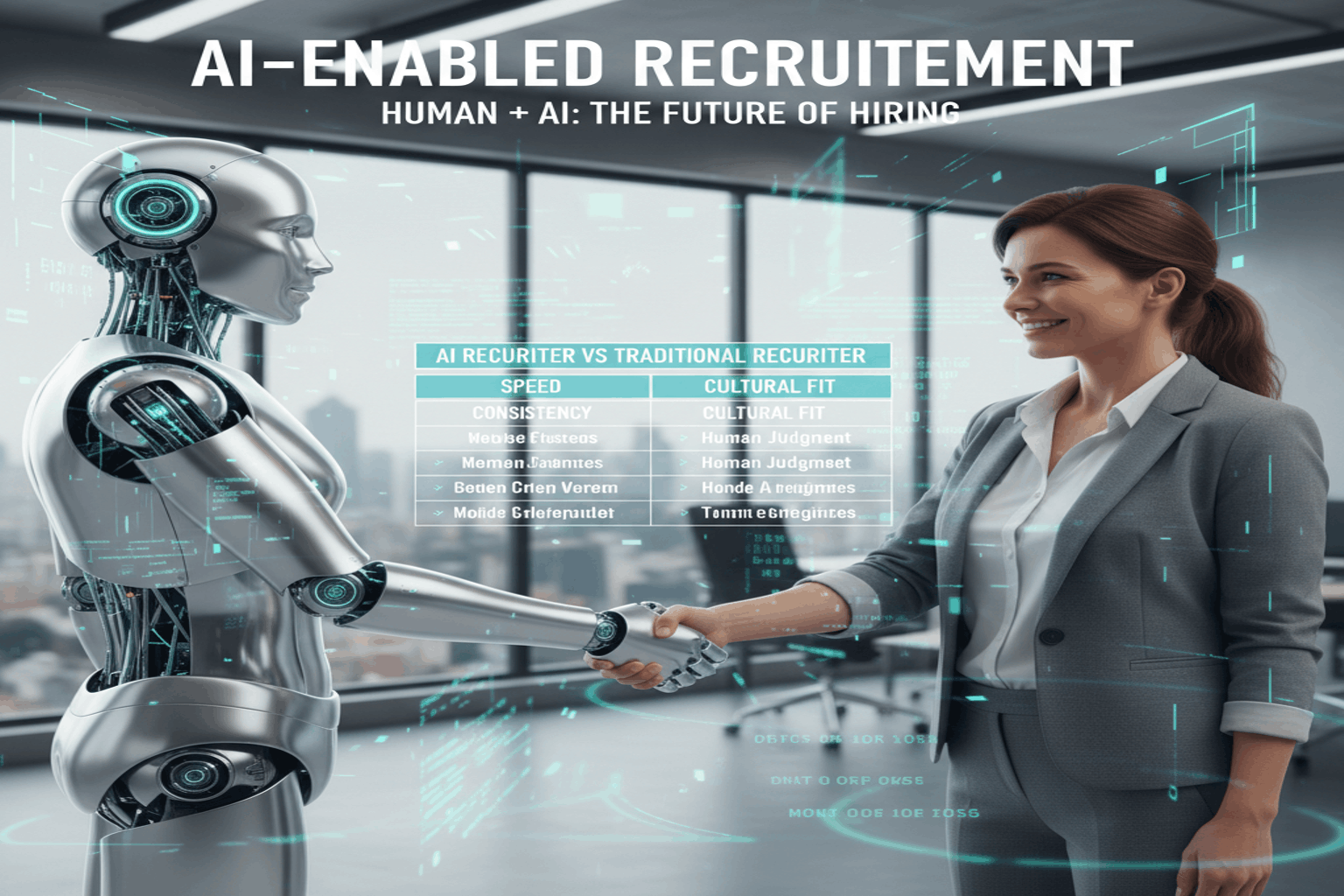
AI Recruiter vs Traditional Recruiter: What HR Leaders Must Know
Recruitment is no longer just about filling roles—it’s about making consistent, fair, and high-quality hiring decisions at scale.
As hiring volumes increase and skill requirements evolve faster than job titles, HR leaders are increasingly evaluating a critical question:
Should recruitment continue to rely primarily on traditional recruiters, or should AI recruiters become a core part of the hiring model?
This article breaks down the reality of AI recruiter vs traditional recruiter, using structured comparison, ROI perspective, and expert commentary—so leaders can make informed, future-ready decisions.
Understanding the Two Models
Before comparing, it’s important to clarify what each model actually represents.
Traditional Recruiter
A human recruiter responsible for sourcing, screening, coordinating interviews, and managing candidate communication—largely through manual or semi-automated processes.
AI Recruiter
An AI-powered system embedded within an ATS that supports recruiters by automating screening, matching candidates to roles based on skills, prioritizing profiles, and generating hiring insights—while humans retain decision authority.
This is not about replacement. It’s about augmentation and scale.
AI Recruiter vs Traditional Recruiter: Side-by-Side Comparison
| Hiring Dimension | Traditional Recruiter | AI Recruiter |
|---|---|---|
| Resume Screening | Manual review, keyword-based | Skill-aware, semantic matching |
| Speed | Limited by human capacity | Scales instantly with volume |
| Consistency | Varies by recruiter | Standardized evaluation logic |
| Bias Risk | Subjective judgment | Bias-reduction through structured data |
| Recruitment Automation | Minimal | Core capability |
| Recruiter Productivity | Capped by time | Multiplied through automation |
| Decision Support | Experience-based | Data + explainable insights |
| Cost Efficiency | Increases with scale | Improves with scale |
Key takeaway:
Traditional recruiters bring human judgment and context. AI recruiters bring speed, structure, and consistency. The future lies in combining both.
The ROI Lens: Why AI Recruiters Are Gaining Ground
While ROI varies by organization, enterprise hiring data consistently highlights where AI recruiters create measurable impact.
1. Time-to-Hire Reduction
AI recruiters automate early-stage screening and prioritization, helping teams focus only on relevant candidates.
Outcome: Faster shortlisting without sacrificing quality.
2. Improved Recruiter Productivity
Recruiters spend a significant portion of their time on repetitive tasks—resume screening, coordination, and status updates.
With recruitment automation:
One recruiter can manage significantly higher requisition loads
Time shifts from screening to stakeholder engagement and candidate experience
Outcome: Higher recruiter productivity without burnout.
3. Better Quality of Hire Signals
AI recruiters evaluate candidates against role-specific skills and competencies rather than surface-level indicators like keywords or employer names.
Outcome: More consistent shortlists and stronger role alignment.
4. Cost Efficiency at Scale
As hiring volume increases, traditional recruitment costs scale linearly with headcount. AI recruiters scale non-linearly.
Outcome: Lower marginal cost per hire in high-volume and enterprise hiring.
Expert Commentary: What HR Leaders Are Getting Wrong
A common misconception is viewing AI recruiters as a replacement for human recruiters.
In reality, the most effective organizations use AI recruiters to:
Eliminate low-value manual work
Bring structure to subjective decisions
Create consistency across teams and geographies
Where Traditional Recruiters Still Matter
Final hiring decisions
Cultural and team fit assessment
Candidate relationship management
Complex or niche roles
Where AI Recruiters Add Maximum Value
High-volume screening
Skill-based shortlisting
Reducing unconscious bias
Providing data-backed hiring insights
The future recruiter is not replaced—it is AI-enabled.
How PeopleXM Thinks About the AI Recruiter Model
At PeopleXM, we don’t believe in “full automation hiring.”
We believe in intelligent recruitment automation that supports human judgment.
Our AI recruiter capabilities are designed to:
Improve recruiter productivity without removing control
Enable skill-first hiring over resume heuristics
Provide explainable insights HR leaders can trust
Scale fairly, consistently, and ethically
The goal is not faster hiring alone—but better hiring decisions, repeated consistently.
Final Thought: Choosing Between AI and Traditional Recruiters Is the Wrong Question
The real question HR leaders should ask is:
“How do we design a hiring model where humans and AI work together—at enterprise scale, with fairness and intelligence?”
Organizations that answer this well will:
Hire better talent
Reduce hiring risk
Future-proof their recruitment function
And that is where the modern AI recruiter becomes a strategic advantage—not a replacement.