
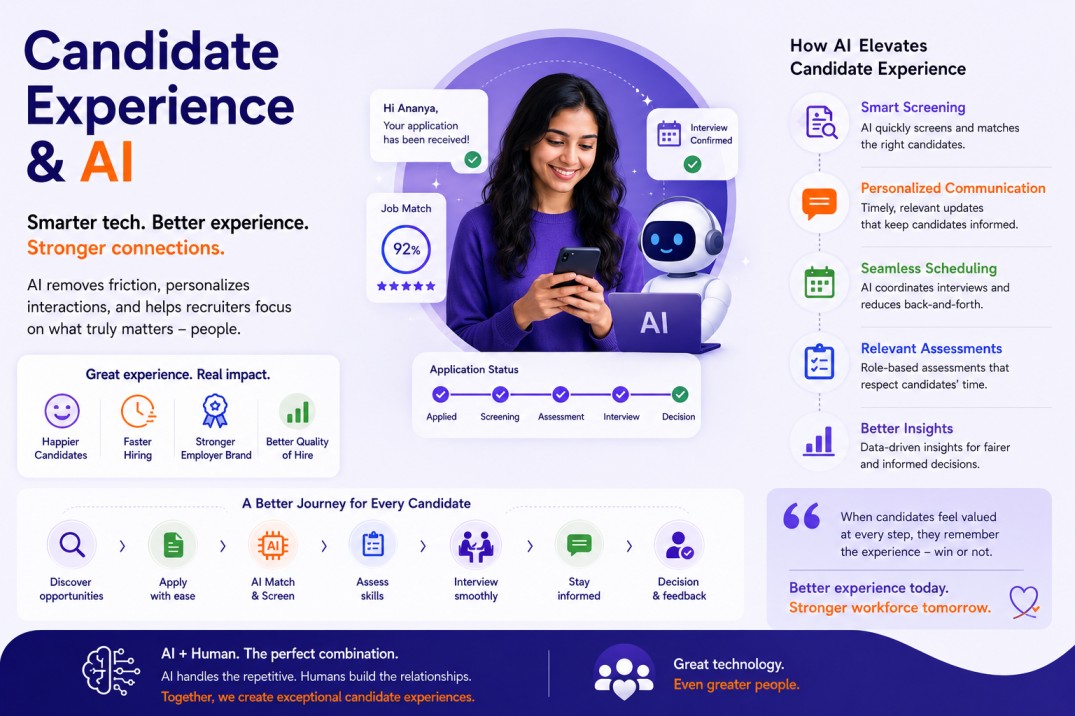
Candidate Experience & AI: How Artificial Intelligence Is Transforming the Recruitment Journey
Recruitment is often viewed from the organization’s perspective.
How quickly can we fill the role?
How many applications did we receive?
How efficiently can recruiters screen candidates?
But there is another side of the hiring process that organizations cannot afford to ignore:
How does the candidate experience the journey?
For candidates, recruitment is not simply a process of submitting a resume and waiting for a response. It is their first meaningful interaction with an organization.
A slow application process, unclear communication, repeated follow-ups, or long periods without updates can create frustration—even when the company has a strong employer brand.
At the same time, recruitment teams are under pressure to manage growing application volumes with limited time.
This is where Artificial Intelligence can play an important role in improving candidate experience.
The purpose of AI in recruitment should not be to remove the human element.
Instead, it should help organizations eliminate unnecessary friction, improve communication, personalize interactions, and allow recruiters to spend more time where human engagement matters most.
What Is Candidate Experience?
Candidate experience refers to the overall perception and experience a job seeker has while interacting with an organization throughout the recruitment process.
This journey can include:
- Discovering a job opportunity
- Reading the job description
- Completing an application
- Receiving communication from the company
- Participating in assessments
- Attending interviews
- Receiving updates
- Receiving an offer—or rejection
Every interaction contributes to how candidates perceive the organization.
A candidate may not receive the job.
But they can still leave with a positive impression if the process is respectful, transparent, and well managed.
Why Candidate Experience Has Become a Recruitment Priority
Today’s candidates have more visibility into employers than ever before.
They research companies before applying. They read employee reviews. They talk to their professional networks. They share their experiences online.
This means recruitment is also part of employer branding.
A poor candidate experience can affect how people perceive an organization—even if they never become employees.
Common frustrations include:
- Applications disappearing without acknowledgment
- Long waiting periods without updates
- Repeating the same information multiple times
- Complex application processes
- Unclear interview schedules
- Lack of feedback
- Poor communication after interviews
For recruitment teams handling hundreds or thousands of applications, solving these challenges manually can be difficult.
That is where AI-powered recruitment technology can help.
The Biggest Candidate Experience Problem: Recruitment Friction
Candidates rarely become frustrated because a company uses technology.
They become frustrated when technology creates unnecessary barriers.
For example:
❌ A candidate spends 30 minutes filling out information already available in their resume.
❌ They receive no confirmation after applying.
❌ They don’t know what happens next.
❌ An interview is scheduled and then repeatedly rescheduled.
❌ They complete an assessment without understanding the process.
❌ They wait weeks without receiving an update.
These problems are not always caused by recruiters.
Often, they are caused by fragmented recruitment processes.
AI and automation can help create a more connected and responsive experience.
How AI Can Improve Candidate Experience
1. Faster Application Processing
Candidates want to know that their application has been received and considered.
AI-assisted recruitment systems can help organizations process large volumes of applications more efficiently.
Instead of applications sitting untouched because recruiters are manually reviewing thousands of resumes, AI can support initial screening and candidate prioritization.
This can help reduce unnecessary delays.
The benefit for candidates:
A faster and more responsive hiring journey.
2. Personalized Candidate Communication
One of the most important aspects of candidate experience is communication.
Candidates want clarity about:
- Whether their application was received
- What happens next
- Whether they need to complete an assessment
- When an interview will take place
- Where they are in the recruitment process
AI and automation can help organizations deliver timely updates at different stages of the hiring journey.
This doesn’t mean every interaction should be automated.
Instead, routine updates can be automated while recruiters focus on conversations that require empathy, judgment, and personal engagement.
3. Smarter Job and Candidate Matching
Traditional recruitment systems often rely heavily on exact keywords.
But candidates may describe their experience differently from the language used in a job description.
AI-powered matching can help evaluate broader relevance by considering factors such as:
- Skills
- Experience
- Role requirements
- Related competencies
- Career progression
This can create a more meaningful connection between candidates and relevant opportunities.
The goal is not simply to process resumes faster.
It is to help candidates be considered for opportunities that genuinely match their capabilities.
4. Reducing Repetitive Application Processes
One of the most frustrating experiences for job seekers is uploading a resume and then manually entering the same information again.
Modern recruitment platforms can help reduce this friction through better data extraction and application workflows.
A smoother application process demonstrates respect for the candidate’s time.
This is a simple but important part of candidate experience.
5. Better Interview Scheduling
Scheduling interviews can involve multiple emails between candidates, recruiters, and hiring managers.
For high-volume recruitment, this can quickly become complicated.
AI-enabled scheduling and workflow automation can help coordinate:
- Available time slots
- Candidate preferences
- Interviewer availability
- Interview reminders
- Rescheduling
The result is a smoother experience for everyone involved.
6. AI-Powered Assessments with Meaningful Insights
Candidates increasingly participate in assessments during recruitment.
But assessments can create a poor experience if they feel irrelevant, excessively long, or disconnected from the role.
A better approach is to use role-relevant skill assessments.
AI-powered assessment platforms can help organizations align assessments more closely with the skills required for a specific position.
This creates a more meaningful experience for candidates while helping recruiters evaluate capabilities beyond the resume.
7. Faster Feedback and Status Updates
One of the most common complaints from candidates is:
“I never heard back.”
Not every organization can provide detailed personalized feedback to thousands of applicants.
However, technology can help organizations provide better communication and clearer status updates.
Candidates should ideally understand whether they are:
- Under review
- Moving to the next stage
- Required to complete an assessment
- Scheduled for an interview
- No longer being considered
Transparency can significantly improve how candidates perceive the hiring process.
AI Should Make Recruitment More Human—Not Less Human
There is a common misconception that AI automatically makes recruitment impersonal.
The opposite can be true when AI is implemented thoughtfully.
Consider how recruiters spend their time.
Without automation, they may spend hours:
- Sorting resumes
- Updating spreadsheets
- Sending repetitive emails
- Coordinating schedules
- Tracking candidate status
With AI and automation supporting these tasks, recruiters can spend more time on:
- Meaningful candidate conversations
- Understanding individual circumstances
- Building relationships
- Supporting hiring managers
- Improving candidate engagement
The best use of AI is not replacing human interaction.
It is removing repetitive work that prevents human interaction from happening.
The AI + Human Recruitment Model
The future of candidate experience is unlikely to be completely automated.
Instead, successful organizations will build a balanced model.
AI Supports:
- Resume screening
- Candidate matching
- Workflow automation
- Communication triggers
- Interview scheduling
- Assessment management
- Recruitment analytics
Humans Lead:
- Relationship building
- Complex conversations
- Interviews
- Contextual decision-making
- Candidate support
- Final hiring decisions
This creates a recruitment model where technology improves efficiency while people provide empathy and judgment.
Personalization Without Losing Privacy
Personalization can improve candidate experience, but organizations must use candidate data responsibly.
AI-powered recruitment systems should be designed with attention to:
- Data privacy
- Transparency
- Responsible data usage
- Appropriate human oversight
- Fair evaluation processes
Candidates should not feel that they are being evaluated by an invisible system they cannot understand.
Responsible AI means organizations should think carefully about how technology is used and where human review is necessary.
AI and Fairness in Candidate Experience
Consistency is another important aspect of candidate experience.
In manual recruitment processes, different candidates may receive different levels of communication or evaluation depending on workload and individual processes.
Technology can help standardize workflows.
For example:
- Candidates receive consistent process information
- Assessments are administered using defined criteria
- Applications follow structured workflows
- Recruiters have better visibility into candidate progress
However, AI is not automatically bias-free.
Organizations should regularly review how AI tools are used and ensure that technology supports fair and relevant evaluation.
The objective should be:
More consistent processes, greater transparency, and appropriate human oversight.
Candidate Experience Across the Recruitment Journey
Let’s look at how AI can support different stages.
Stage 1: Job Discovery
AI can help connect candidates with relevant opportunities based on skills and experience.
Candidate benefit:
More relevant opportunities.
Stage 2: Application
Better workflows can reduce repetitive forms and unnecessary friction.
Candidate benefit:
A faster and easier application process.
Stage 3: Screening
AI-assisted systems can help recruiters process applications efficiently.
Candidate benefit:
Reduced waiting time.
Stage 4: Assessment
Role-based assessments can evaluate relevant capabilities.
Candidate benefit:
A clearer and more meaningful evaluation process.
Stage 5: Interview
Scheduling automation and structured workflows can simplify coordination.
Candidate benefit:
Better communication and fewer delays.
Stage 6: Decision and Communication
Automated workflows can help ensure candidates receive timely updates.
Candidate benefit:
Greater transparency.
How PeopleXM Supports a Better Candidate Experience
PeopleXM is designed around the idea that modern recruitment should be both efficient for recruiters and meaningful for candidates.
An AI-powered hiring platform can help bring different parts of the recruitment journey together, including:
- AI-assisted resume screening
- JD-based candidate matching
- Smart skill assessments
- Candidate workflow management
- Automated recruitment processes
- Interview coordination
- Candidate insights
- Talent rediscovery
The objective is not simply to automate recruitment.
It is to reduce unnecessary friction throughout the hiring journey.
When recruiters have better tools and clearer candidate insights, they can focus more attention on meaningful hiring interactions.
Measuring Candidate Experience
Organizations should not rely only on assumptions.
Candidate experience can be measured through indicators such as:
Application Completion Rate
How many candidates successfully complete the application process?
A low completion rate may indicate unnecessary complexity.
Candidate Drop-Off Rate
At which stage are candidates leaving the recruitment process?
This can reveal friction in applications, assessments, or interview workflows.
Time Between Hiring Stages
How long are candidates waiting for updates?
Long delays can negatively affect the candidate experience.
Interview Scheduling Time
How efficiently are interviews being coordinated?
Candidate Feedback
What do candidates say about their experience?
Surveys and feedback can provide valuable insights that recruitment analytics alone cannot.
Common Mistakes When Using AI for Candidate Experience
AI can improve recruitment, but implementation matters.
Here are some common mistakes organizations should avoid.
1. Automating Everything
Not every candidate interaction should be automated.
Sensitive conversations and important decisions require human involvement.
2. Using Generic Communication
Automation should not result in confusing or irrelevant messages.
Communication should be clear and relevant to the candidate’s stage.
3. Creating Complex Assessments
Technology should simplify evaluation—not create unnecessary barriers.
Assessments should be relevant to the role and respectful of candidates’ time.
4. Removing Human Oversight
AI should support recruiters, not become an unquestioned decision-maker.
Human review remains essential.
5. Ignoring Candidate Feedback
Technology provides data, but candidates provide context.
Organizations should continuously listen to candidate feedback and improve their processes.
The Future of Candidate Experience and AI
The future of recruitment will likely become more personalized, responsive, and data-informed.
Candidates will increasingly expect:
- Faster responses
- Relevant opportunities
- Clear communication
- Flexible interview experiences
- Personalized interactions
- Transparent processes
AI can help organizations meet these expectations at scale.
But the organizations that succeed won’t necessarily be the ones using the most automation.
They will be the ones using technology thoughtfully.
The future belongs to recruitment teams that understand a simple principle:
Efficiency and empathy do not have to compete.
With the right technology, organizations can build hiring processes that are faster for recruiters and better for candidates.
Conclusion: Better Technology Can Create Better Human Experiences
Candidate experience is no longer a secondary part of recruitment.
It is part of employer branding, talent attraction, and long-term business reputation.
AI offers an opportunity to improve recruitment by reducing delays, simplifying workflows, personalizing communication, and helping recruiters focus on meaningful interactions.
But AI should never remove the human side of hiring.
Its greatest value comes from helping people do what technology cannot:
Listen. Understand. Connect. And make thoughtful decisions.
A strong candidate experience combines the efficiency of AI with the empathy of human recruiters.
That is the direction modern recruitment is moving toward—and platforms like PeopleXM can help organizations build a smarter, more connected, and candidate-friendly hiring journey.