
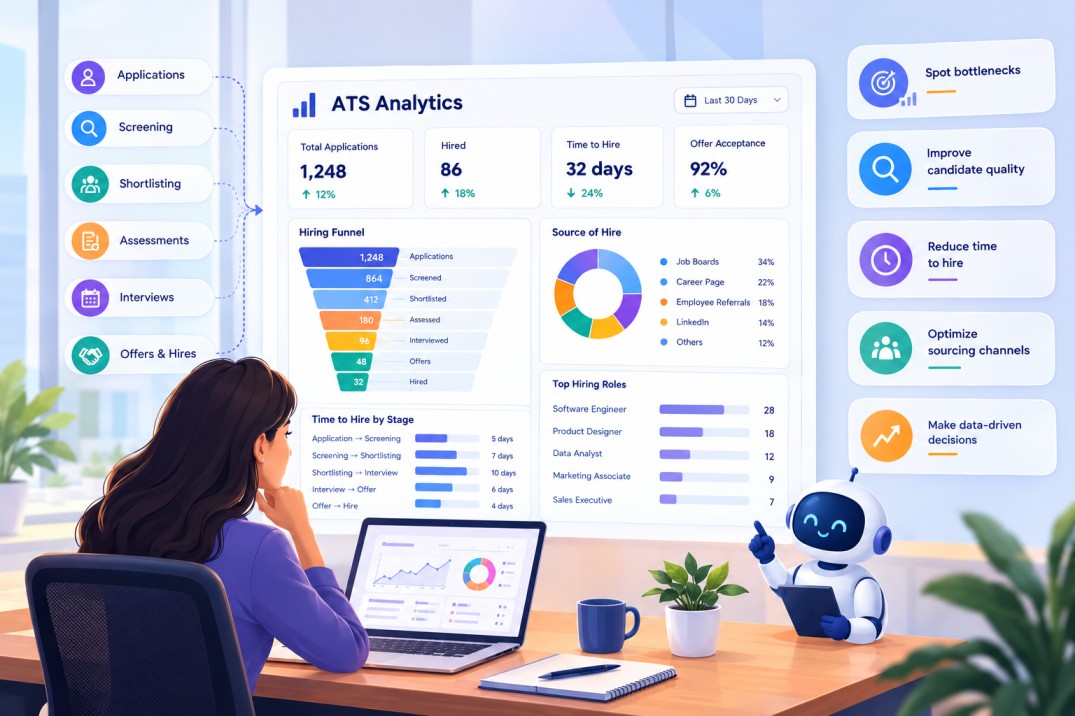
ATS Analytics: How Recruitment Data Improves Hiring Decisions | PeopleXM
Recruitment generates an enormous amount of data.
Every job application, resume, assessment, interview, rejection, offer, and hire creates another data point.
Yet many recruitment teams still struggle to turn this information into meaningful insight.
They may know how many candidates applied for a role.
But can they answer:
- Where are candidates dropping out?
- Which sourcing channels produce the strongest candidates?
- How long does screening actually take?
- Which roles are creating the biggest bottlenecks?
- Are recruiters spending too much time on administrative work?
- Which candidates are progressing successfully through the funnel?
- Where can the hiring process be improved?
This is where ATS analytics becomes valuable.
A modern Applicant Tracking System should not simply track candidates.
It should help recruitment leaders understand the hiring process itself.
The real value of ATS analytics isn’t the number of charts on a dashboard.
It’s the quality of decisions those insights enable.
What Is ATS Analytics?
ATS analytics refers to the collection, analysis, and visualization of recruitment data generated through an Applicant Tracking System.
It can provide visibility across different stages of the hiring lifecycle, including:
- Job creation
- Candidate applications
- Resume screening
- Shortlisting
- Assessments
- Interviews
- Offers
- Hiring
- Candidate drop-offs
Instead of relying on spreadsheets and manually prepared reports, recruitment teams can use centralized data to monitor hiring performance.
For HR leaders, this creates an opportunity to move from:
“What happened?”
to:
“Why did it happen, and what should we do next?”
Why Recruitment Teams Need Better Analytics
Recruitment is often measured using a handful of familiar metrics such as time-to-hire and number of hires.
These metrics are useful—but they don’t always tell the complete story.
Imagine a company takes 45 days to fill a position.
Is that a recruitment problem?
Maybe.
But what if:
- The role was approved late.
- The job description was unclear.
- Applications were strong but screening took too long.
- Hiring managers took two weeks to provide interview feedback.
- Candidates dropped out because of delays.
The overall hiring time tells you what happened.
Detailed ATS analytics can help reveal where the delay occurred.
That distinction matters.
The Recruitment Funnel: Where ATS Analytics Creates Visibility
A typical recruitment funnel may look like:
Applications → Screening → Shortlisting → Assessment → Interview → Offer → Hire
At every stage, candidates can move forward, drop out, or remain stuck.
ATS analytics can help recruitment teams understand the conversion between these stages.
For example:
1,000 Applications
↓
300 Candidates Screened
↓
100 Shortlisted
↓
50 Assessed
↓
20 Interviewed
↓
5 Offers
↓
4 Hires
The numbers themselves are useful.
But the real questions are:
Why did 700 candidates not progress?
Are the screening criteria too restrictive?
Are assessments identifying the right candidates?
Why did one candidate reject the offer?
Analytics turns these questions into measurable recruitment problems.
Key ATS Analytics Metrics Recruitment Leaders Should Track
Not every organization needs dozens of metrics.
The objective should be to track the metrics that help answer important business and recruitment questions.
1. Application Volume
Application volume shows how many candidates are entering the recruitment funnel.
It can help organizations understand:
- Which roles attract the most candidates
- Which roles struggle to attract applicants
- How application volume changes over time
- Whether sourcing strategies are generating sufficient reach
However, more applications do not necessarily mean better recruitment.
Quality matters as much as volume.
2. Screening Efficiency
Screening is often one of the biggest bottlenecks in high-volume recruitment.
Analytics can help organizations understand:
- Number of applications screened
- Screening turnaround time
- Candidates progressing from screening
- Recruiter workload
- Screening-to-interview conversion
This can reveal whether recruitment teams are spending too much time processing applications.
3. Candidate Conversion Rates
Conversion rates help teams understand how candidates move through the hiring funnel.
For example:
Application → Screening
Screening → Assessment
Assessment → Interview
Interview → Offer
Offer → Hire
A significant drop between two stages can indicate a problem worth investigating.
Perhaps candidates are not meeting the requirements.
Perhaps the assessment is not aligned with the role.
Perhaps the interview process is too long.
The data doesn’t automatically provide the answer—but it shows recruiters where to investigate.
4. Time-to-Hire
Time-to-hire remains an important recruitment metric.
But it becomes more useful when broken into individual stages.
For example:
- Application to screening
- Screening to assessment
- Assessment to interview
- Interview to decision
- Decision to offer
This helps recruitment leaders identify the actual source of delays.
Instead of saying:
“Hiring is taking too long.”
They can identify:
“The biggest delay is occurring between final interviews and hiring decisions.”
That is a much more actionable insight.
5. Source-of-Hire Analytics
Where do your best candidates come from?
Candidates may enter through:
- Job boards
- Careers pages
- Employee referrals
- Campus hiring
- Recruitment agencies
- Social platforms
- Talent databases
ATS analytics can help compare sources based on more than application volume.
A source generating 1,000 applications may appear successful.
But another source generating 150 applications could produce significantly more interview-ready or hired candidates.
This is why recruitment teams should evaluate quality and conversion, not just volume.
6. Cost and Resource Efficiency
Recruitment teams operate within budgets.
Analytics can help HR leaders understand how recruitment resources are being used.
Depending on the organization’s data and integrations, teams can evaluate factors such as:
- Cost per hire
- Recruitment spend by source
- Recruiter workload
- Agency dependence
- Hiring volume by recruiter
- Time spent at different stages
This can support better allocation of recruitment resources.
7. Candidate Drop-Off
Not every candidate who enters the hiring funnel reaches the end.
Candidates may leave because of:
- Long waiting periods
- Complex application processes
- Lack of communication
- Poor interview experiences
- Uncompetitive offers
- Better opportunities elsewhere
ATS analytics can help identify where candidate drop-off is happening.
This is especially valuable when combined with candidate feedback.
The objective isn’t simply to reduce drop-off at any cost.
It is to understand why candidates leave and whether the process itself is contributing to unnecessary attrition.
8. Offer Acceptance Rate
An organization may successfully identify and interview strong candidates but still struggle to convert offers into hires.
Offer acceptance analytics can help reveal patterns across:
- Roles
- Locations
- Departments
- Experience levels
- Hiring periods
If offer acceptance consistently declines for a particular role, recruitment leaders can investigate factors such as compensation, expectations, process delays, or candidate engagement.
ATS Analytics for High-Volume Hiring
Analytics becomes even more important when organizations hire at scale.
High-volume recruitment can involve hundreds or thousands of candidates across multiple positions.
Without centralized analytics, recruiters can struggle to understand:
- Which candidates have already been evaluated
- Which roles have the largest candidate pools
- Where screening is slowing down
- Which recruiters have the highest workloads
- Which hiring stages have the greatest backlog
An AI-powered ATS can combine automation + analytics to make high-volume recruitment more manageable.
Automation helps process the volume.
Analytics helps understand the process.
From Recruitment Reports to Recruitment Intelligence
There is an important difference between reporting and intelligence.
Reporting tells you:
- 2,000 candidates applied.
- 300 candidates were interviewed.
- 40 offers were made.
- 30 candidates joined.
Intelligence asks:
- Why did 1,700 candidates not progress?
- Which skills were most common among successful candidates?
- Which sourcing channel produced the strongest hires?
- Where did candidates spend the most time waiting?
- Which roles have recurring skill shortages?
- What should recruiters change in the next hiring cycle?
This is where modern ATS analytics becomes strategically valuable.
The goal isn’t more data.
The goal is better decisions.
How AI Can Make ATS Analytics More Useful
Traditional dashboards require users to interpret data manually.
AI can add another layer by helping identify patterns and relationships within recruitment data.
For example, an AI-enabled recruitment platform could help surface:
- Recurring hiring bottlenecks
- Skill gaps among applicants
- Candidate funnel patterns
- Roles with difficult-to-fill requirements
- Changes in candidate quality
- Recruitment stage delays
This can help recruiters move from manually searching through reports toward focusing on the insights that require attention.
However, AI-generated insights should be treated as decision support, not unquestionable conclusions.
Recruitment leaders still need context.
ATS Analytics and Quality of Hire
One of the biggest limitations of traditional recruitment reporting is that hiring often ends when the candidate joins.
But the real test begins after hiring.
Did the person perform well?
Did they remain with the organization?
Did they meet role expectations?
Did the skills identified during recruitment translate into workplace performance?
Connecting recruitment data with downstream outcomes can eventually help organizations understand which hiring signals actually matter.
This moves recruitment analytics toward a more strategic question:
What characteristics are associated with successful hires in our organization?
ATS Analytics and Skills-Based Hiring
As organizations move toward skills-based hiring, analytics can provide visibility into the capabilities represented within the candidate pool.
Recruitment teams can analyze:
- Most common candidate skills
- Skills frequently missing from applications
- Skills associated with successful candidates
- Assessment performance
- Skill gaps by role
- Skill availability across the talent pool
This can help organizations understand not only who is applying, but also what capabilities are available in the market.
Using ATS Analytics to Improve Recruiter Performance
Analytics should not become a tool for simply monitoring recruiter activity.
Used properly, it can help recruitment leaders identify where teams need support.
For example:
If one recruiter manages significantly more candidates, workload distribution may need adjustment.
If candidates consistently wait several days at one stage, the workflow may need improvement.
If one sourcing channel generates large volumes but very few qualified candidates, the recruitment strategy may need to change.
The best analytics systems help answer:
“How can we improve the process?”
rather than simply:
“Who is responsible for the delay?”
ATS Analytics and Candidate Experience
Recruitment analytics also has a human dimension.
A candidate may experience:
- Long application processing times
- Delayed interview scheduling
- Lack of communication
- Repeated assessment requests
- Slow hiring decisions
Recruiters may see these as individual incidents.
Analytics can reveal whether they are actually systemic problems.
For example, if candidates consistently spend several days waiting between interviews and decisions, the organization has an opportunity to improve the candidate experience.
This is where recruitment data can influence employer brand—not just recruitment efficiency.
Responsible Use of Recruitment Data
More recruitment data also means greater responsibility.
Organizations should consider:
- What candidate information is being collected?
- Why is it being collected?
- Who has access to it?
- How long is it retained?
- How is AI being used to analyze it?
- Are candidates being evaluated using relevant criteria?
- Is human oversight maintained?
Analytics should help organizations make better decisions without compromising candidate privacy, fairness, or trust.
Data-driven hiring should still be human-centered hiring.
How PeopleXM Approaches ATS Analytics
PeopleXM brings an AI-first approach to recruitment, helping organizations move from basic candidate tracking toward more intelligent hiring workflows.
Its recruitment ecosystem can bring together candidate data from processes such as:
- AI-assisted resume screening
- JD-based candidate matching
- Skill assessments
- Candidate evaluation
- Recruitment workflows
- Talent rediscovery
- Psychometric insights
- Hiring analytics
The value of bringing these processes together is visibility.
Recruitment teams can gain a clearer understanding of candidate movement, skills, assessment performance, and hiring activity rather than managing disconnected information across multiple systems.
The objective is not to create another dashboard.
It is to help HR and TA leaders make better decisions using the data already generated throughout the hiring process.
A Practical Framework for Using ATS Analytics
HR leaders can use a simple four-step framework:
1. Measure
Start by identifying the recruitment metrics that matter to your organization.
2. Diagnose
Look for unusual patterns, delays, drop-offs, and conversion gaps.
3. Act
Change the recruitment workflow, sourcing strategy, screening criteria, or candidate engagement approach.
4. Learn
Monitor the results and determine whether the change actually improved the outcome.
This creates a continuous improvement cycle:
Measure → Diagnose → Act → Learn → Repeat
What Should HR Leaders Look for in an ATS Analytics Platform?
Before selecting an ATS, consider whether its analytics capabilities answer real business questions.
Look for:
Real-time visibility
Can recruitment leaders see what is happening across open positions?
Funnel analytics
Can they understand candidate movement between stages?
Source analytics
Can they evaluate the quality of different talent sources?
Role-level insights
Can teams identify difficult-to-fill roles?
Skill insights
Can they understand candidate capabilities and gaps?
Recruiter productivity insights
Can they identify workflow bottlenecks without reducing performance to activity counts?
Custom reporting
Can different stakeholders access the information relevant to their roles?
AI-assisted insights
Can the system help identify meaningful patterns without removing human oversight?
The Future of ATS Analytics
The ATS is evolving.
It is no longer simply a digital filing cabinet for resumes.
As recruitment becomes increasingly data-driven, the ATS is becoming a source of talent intelligence.
The next generation of recruitment analytics will increasingly connect:
Candidate Data
↓
Skills & Assessments
↓
Recruitment Funnel
↓
Hiring Decisions
↓
Workforce Outcomes
This creates a more complete view of the relationship between recruitment activity and business outcomes.
The organizations that use this data effectively will be better positioned to continuously improve how they attract, evaluate, and hire talent.
Conclusion: The Best ATS Analytics Answer One Question
Recruitment teams don’t need dashboards simply because dashboards are available.
They need analytics because hiring decisions have consequences.
The right ATS analytics can help organizations understand:
- Where hiring slows down
- Where candidates drop out
- Which sources deliver quality talent
- Which skills are available
- Where recruiters need support
- Which recruitment stages need improvement
- How efficiently the hiring funnel is performing
The ultimate goal is not to measure recruitment for the sake of measurement.
It is to turn recruitment data into actionable intelligence.
For HR leaders and talent acquisition teams, that means moving beyond:
“How many candidates did we process?”
toward:
“What did we learn from our hiring process—and how can we make the next hire better?”
That is the real promise of ATS analytics.
Explore PeopleXM and turn recruitment data into better hiring decisions.