
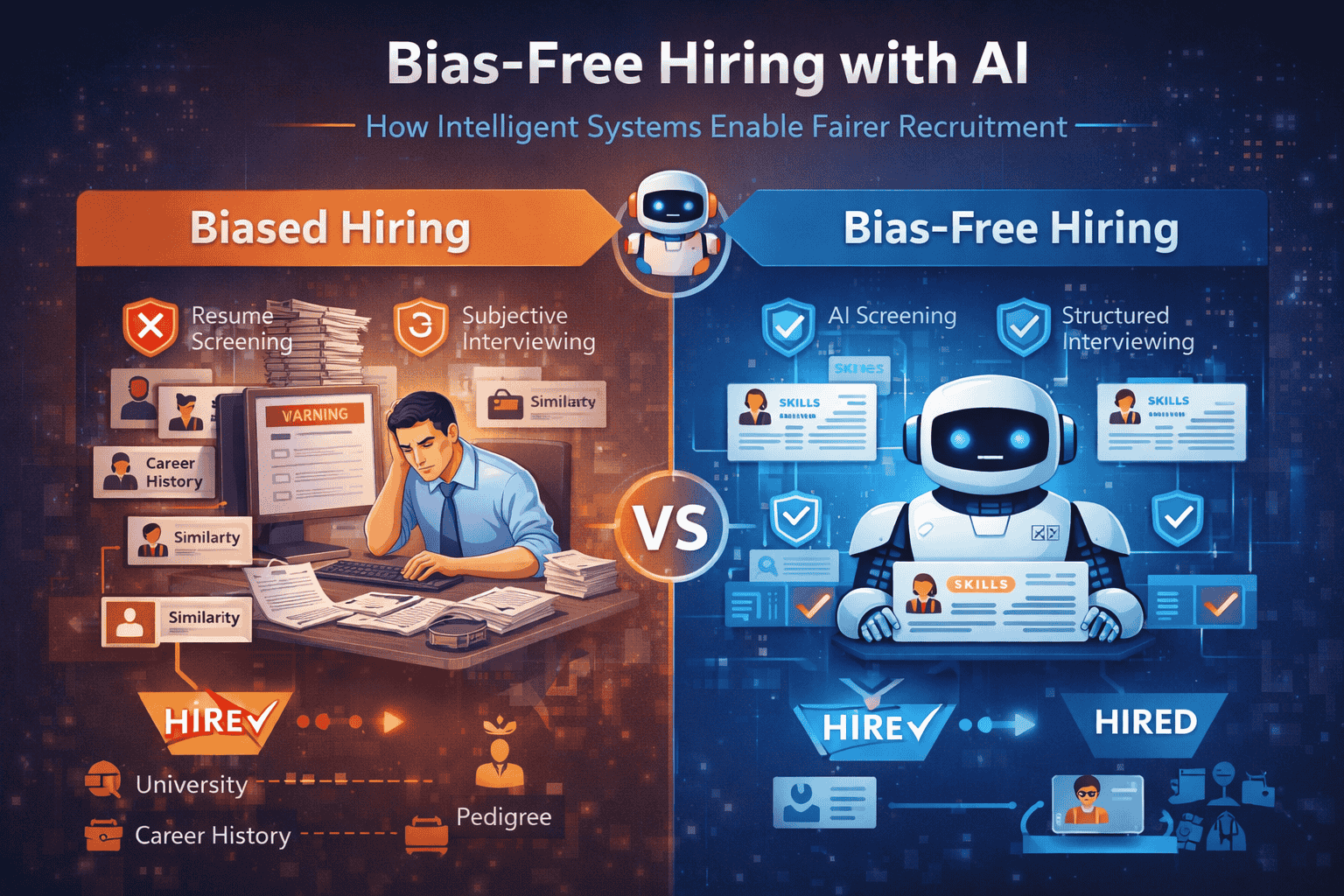
Bias-Free Hiring with AI: How Intelligent Systems Enable Fairer Recruitment
Hiring decisions shape the future of organizations.
Yet, despite structured interviews and standardized workflows, bias remains one of the most persistent challenges in recruitment. Often unintentional, bias can influence how resumes are reviewed, how candidates are evaluated, and ultimately, who gets hired.
As organizations focus more on fairness, diversity, and accountability, many HR leaders are exploring how AI can support bias-free hiring — not by replacing human judgment, but by strengthening it.
This article explores how bias enters hiring processes, how AI helps reduce it, and what organizations should consider when implementing ethical AI-driven recruitment systems.
What Does Bias-Free Hiring Really Mean?
Bias-free hiring does not mean removing human judgment.
It means minimizing unfair influence so that hiring decisions are based on skills, experience, and role relevance, rather than assumptions or unconscious preferences.
Bias can appear in subtle ways, including:
- Favoring familiar educational institutions
- Preferring certain names or locations
- Overvaluing specific career paths
- Making subjective judgments during screening
Even experienced recruiters can unintentionally develop patterns that influence decision-making.
Bias-free hiring focuses on consistency, fairness, and structured evaluation — not perfection.
Where Bias Commonly Enters the Hiring Process
Bias rarely begins at the interview stage alone. It often starts much earlier.
Understanding these entry points is the first step toward reducing bias.
1. Resume Screening
Manual resume screening introduces several bias risks.
For example:
- Selecting candidates based on familiar universities
- Overlooking non-traditional career paths
- Filtering resumes based on keyword assumptions
- Prioritizing candidates from specific industries
When recruiters manually review hundreds of resumes, fatigue and time pressure can further amplify bias.
2. Job Description Design
Bias can begin even before candidates apply.
Job descriptions that include:
- Gender-coded language
- Overly rigid qualification criteria
- Unnecessary experience requirements
can unintentionally discourage qualified candidates from applying.
Structured and inclusive job descriptions play a critical role in fairness.
3. Interview Evaluations
Interview bias can occur through:
- First impressions
- Similarity bias (preferring candidates who resemble oneself)
- Confirmation bias
- Inconsistent evaluation criteria
Without standardized scoring systems, interview outcomes can vary widely between evaluators.
How AI Supports Bias-Free Hiring
AI does not eliminate bias automatically — but when designed responsibly, it helps create structured, consistent hiring processes that reduce human subjectivity.
The strength of AI lies in standardization and pattern-based decision support.
1. Standardized Resume Evaluation
AI-powered systems evaluate candidates using predefined criteria, reducing reliance on subjective judgments.
Instead of scanning resumes manually, AI systems:
- Identify skills and competencies
- Compare candidates based on job relevance
- Prioritize role-specific alignment
This ensures that every candidate is assessed using the same evaluation logic.
Consistency is one of the most powerful tools for reducing bias.
2. Skill-Based Matching Instead of Profile Bias
Traditional hiring often emphasizes:
- Degrees
- Company names
- Career pedigree
AI-driven systems shift focus toward:
Skills, capabilities, and role readiness
Skill-based hiring helps organizations discover:
- Non-traditional candidates
- Transferable skill holders
- High-potential talent outside conventional paths
This broadens talent access while improving fairness.
3. Structured Interview Scoring
AI-enabled systems support structured evaluation frameworks.
These frameworks:
- Define scoring criteria
- Standardize interviewer inputs
- Reduce reliance on memory or subjective impressions
When multiple interviewers evaluate candidates using the same structure, decision consistency improves significantly.
4. Bias Monitoring and Auditability
Responsible AI systems maintain transparent evaluation records.
This allows organizations to:
- Review hiring decisions
- Identify patterns in candidate selection
- Monitor fairness across candidate groups
Transparency is essential for building trust in AI-supported hiring.
The Role of Ethical AI in Hiring
Bias-free hiring is not just a technical challenge — it is an ethical responsibility.
AI systems must be designed with fairness, transparency, and accountability in mind.
Key ethical considerations include:
1. Transparent Decision Logic
HR teams should understand:
- How candidate recommendations are generated
- What criteria influence candidate ranking
- How role fit is evaluated
Black-box systems that provide results without explanation create risk.
Transparency supports trust and compliance.
2. Human Oversight Remains Essential
AI supports decision-making — it does not replace human accountability.
Final hiring decisions should always involve:
- Recruiter judgment
- Hiring manager evaluation
- Contextual understanding
Human oversight ensures that nuance is preserved.
3. Continuous Model Monitoring
AI models evolve over time.
Organizations must:
- Regularly review outcomes
- Validate fairness metrics
- Adjust evaluation logic when needed
Bias-free hiring requires ongoing governance, not one-time implementation.
Business Benefits of Bias-Free Hiring with AI
Fair hiring is not only ethical — it is operationally valuable.
Organizations that reduce bias often see measurable improvements in hiring performance.
1. Expanded Talent Pools
Removing rigid filters allows organizations to discover candidates who might otherwise be overlooked.
This increases:
- Candidate diversity
- Skill availability
- Hiring flexibility
Expanded pools lead to better hiring outcomes.
2. Improved Hiring Consistency
Structured evaluation improves:
- Decision alignment
- Hiring fairness
- Candidate experience
Consistency strengthens employer credibility.
3. Reduced Hiring Risk
Bias-related hiring mistakes can lead to:
- Misaligned hires
- Compliance risks
- Reputational challenges
AI-supported standardization helps reduce variability and improve defensibility in hiring decisions.
4. Stronger Employer Brand Trust
Candidates increasingly value fair hiring practices.
Organizations that demonstrate structured and transparent hiring processes are more likely to:
- Build candidate trust
- Improve offer acceptance rates
- Strengthen employer reputation
Fairness is becoming a competitive advantage.
Common Misconceptions About AI and Hiring Bias
Despite growing adoption, misconceptions about AI and bias remain common.
Myth 1: AI Automatically Eliminates Bias
Reality: AI reduces bias only when designed and governed responsibly.
Poorly designed AI systems can replicate existing biases.
Responsible implementation matters.
Myth 2: Bias-Free Hiring Means Ignoring Experience
Reality: Bias-free hiring prioritizes relevant experience, not superficial signals.
It strengthens evaluation — not weakens standards.
Myth 3: AI Removes Human Control
Reality: AI strengthens human decisions by providing structured insights.
Recruiters remain central to hiring outcomes.
AI enhances — it does not replace — judgment.
What HR Leaders Should Look for in Bias-Aware AI Hiring Platforms
Not all AI hiring tools are designed with fairness in mind.
HR leaders should evaluate platforms carefully.
Look for systems that:
- Support structured evaluation workflows
- Enable skill-based hiring models
- Provide transparent decision insights
- Allow human review and overrides
- Maintain audit-ready hiring records
These capabilities ensure that technology strengthens fairness rather than compromising it.
The Future of Hiring Is Fair, Structured, and Data-Informed
Hiring is evolving from intuition-driven decisions to evidence-supported outcomes.
Bias-free hiring is not about removing human judgment — it is about strengthening decision quality through structure and intelligence.
Organizations that adopt responsible AI-driven hiring practices are not only improving fairness — they are building more resilient, inclusive, and high-performing teams.
The future of hiring will not belong to the fastest organizations alone.
It will belong to the fairest and most consistent one