
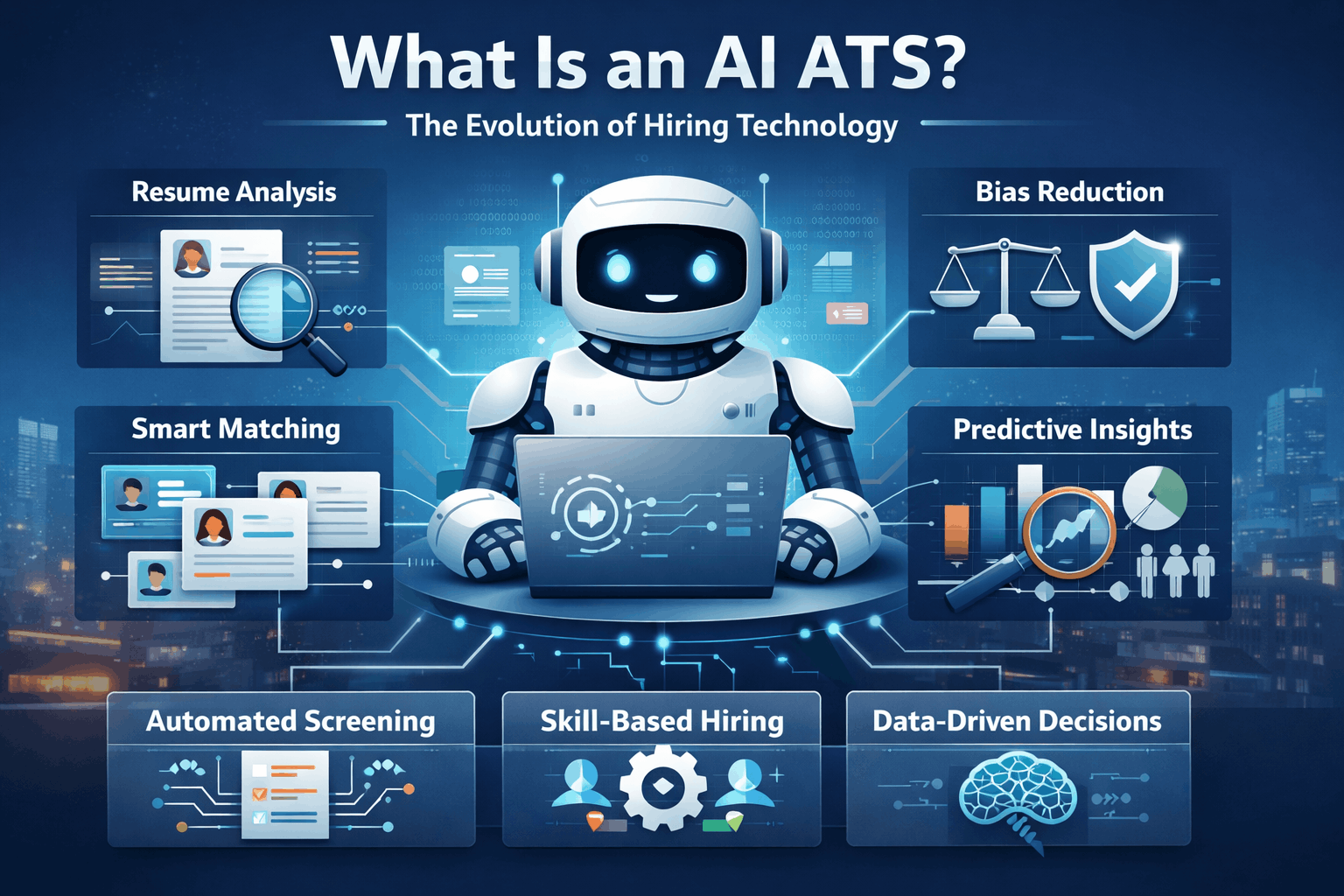
What Is an AI ATS? A Complete Guide for Modern HR Leaders
Hiring today is no longer about collecting resumes — it’s about making faster, fairer, and more informed hiring decisions.
Traditional Applicant Tracking Systems (ATS) were designed to store resumes and manage workflows. But modern hiring demands more than tracking — it requires intelligence.
This is where an AI ATS (Artificial Intelligence Applicant Tracking System) changes the game.
In this guide, we’ll break down what an AI ATS is, how it works, why organizations are adopting it, and what HR leaders should look for when evaluating AI-powered hiring platforms.
What Is an AI ATS?
An AI ATS is an Applicant Tracking System enhanced with artificial intelligence that helps recruiters automate repetitive tasks, analyze candidate data intelligently, and make more accurate hiring decisions.
Unlike traditional ATS platforms that primarily store resumes and track candidate progress, an AI ATS actively interprets data, identifies patterns, and supports decision-making throughout the hiring lifecycle.
At its core, an AI ATS transforms recruitment from a process-driven workflow into a decision-driven system.
How Is an AI ATS Different From a Traditional ATS?
Many organizations assume their existing ATS is “AI-enabled,” but the difference between a traditional ATS and an AI ATS is significant.
Traditional ATS vs AI ATS: Key Differences
| Capability | Traditional ATS | AI ATS |
|---|---|---|
| Resume Storage | Stores resumes | Understands resume context |
| Candidate Matching | Keyword-based filtering | Semantic and skill-based matching |
| Screening | Manual-heavy | Automated and intelligent |
| Decision Support | Limited | Data-driven recommendations |
| Bias Control | Minimal | Structured and bias-aware workflows |
| Speed | Slower due to manual steps | Faster through automation |
Traditional ATS systems are built to manage hiring, while AI ATS platforms are built to optimize hiring outcomes.
This shift is especially critical for organizations handling large candidate volumes or hiring across multiple roles simultaneously.
How Does an AI ATS Work?
An AI ATS combines machine learning, natural language processing (NLP), and predictive analytics to support recruiters throughout the hiring process.
While implementations vary, most AI ATS platforms operate through several key layers.
1. Intelligent Resume Parsing
AI-powered systems automatically extract structured information from resumes such as:
- Skills
- Work experience
- Certifications
- Education
- Career progression
More importantly, they understand context, not just keywords.
For example:
A traditional ATS may treat “Project Coordination” and “Project Management” as unrelated keywords.
An AI ATS recognizes their relationship and evaluates candidates accordingly.
2. Semantic Candidate Matching
Instead of matching resumes using simple keywords, AI ATS platforms use semantic matching.
This allows the system to:
- Identify transferable skills
- Recognize role relevance
- Understand industry-specific terminology
- Rank candidates based on skill fit
This reduces the risk of overlooking qualified candidates due to rigid keyword filters.
3. Automated Screening and Ranking
AI ATS platforms help recruiters focus on the most relevant candidates first.
Key capabilities include:
- Shortlisting candidates based on role fit
- Ranking applicants using skill alignment
- Filtering large candidate pools
- Reducing manual screening workload
This is particularly valuable in high-volume hiring environments where recruiters may receive hundreds — or thousands — of applications per role.
4. Predictive Hiring Insights
Advanced AI ATS platforms provide insights such as:
- Candidate fit probability
- Hiring pipeline bottlenecks
- Time-to-hire predictions
- Role success indicators
These insights shift hiring from reactive to strategic.
Why Organizations Are Moving to AI ATS Platforms
Hiring complexity has increased dramatically in recent years.
More applicants. More roles. More competition.
At the same time, HR teams are expected to deliver better hiring outcomes with fewer resources.
AI ATS platforms address these pressures directly.
1. Resume Volume Is Increasing Rapidly
Recruiters often face overwhelming volumes of resumes.
Manual screening at scale leads to:
- Missed qualified candidates
- Delayed hiring decisions
- Recruiter fatigue
- Inconsistent evaluations
AI ATS platforms help teams manage volume without sacrificing quality.
2. Speed Has Become a Competitive Advantage
Top candidates don’t stay available for long.
Organizations with slow hiring cycles often lose talent to faster competitors.
AI ATS platforms reduce delays by:
- Automating screening
- Prioritizing high-fit candidates
- Streamlining decision workflows
This improves time-to-hire without reducing evaluation quality.
3. Hiring Quality Matters More Than Ever
Hiring mistakes are expensive.
Beyond salary costs, poor hires impact:
- Team productivity
- Manager bandwidth
- Employee morale
- Organizational performance
AI-driven decision support improves alignment between candidate capabilities and role expectations.
4. Fairness and Bias Reduction Are Strategic Priorities
Modern organizations are placing increased focus on fair and ethical hiring.
AI ATS platforms support structured evaluation processes that help:
- Standardize candidate assessments
- Reduce subjective decision-making
- Promote consistency across hiring teams
Responsible AI design remains critical to ensuring fairness.
Key Features to Look for in an AI ATS
Not every ATS labeled “AI-powered” delivers meaningful intelligence.
HR leaders should evaluate capabilities carefully.
1. True Semantic Matching (Not Just Keywords)
Look for systems that:
- Understand skill relationships
- Interpret experience context
- Support role-based intelligence
Keyword filtering alone is not sufficient for modern hiring.
2. Skill-Based Candidate Evaluation
Skill intelligence is becoming central to hiring success.
An effective AI ATS should:
- Identify verified skills
- Support skill-based hiring models
- Enable structured comparisons between candidates
This shifts hiring focus from resumes to capabilities.
3. Workflow Automation
Automation should reduce administrative workload, not remove recruiter judgment.
Look for:
- Automated shortlisting
- Interview scheduling support
- Pipeline tracking automation
Recruiters should spend more time evaluating candidates — not managing spreadsheets.
4. Hiring Analytics and Decision Insights
Modern hiring requires visibility.
Strong AI ATS platforms provide:
- Hiring funnel analytics
- Drop-off insights
- Time-to-hire metrics
- Source performance tracking
These insights support continuous hiring improvement.
5. Bias Awareness and Ethical AI Controls
Responsible hiring requires transparency.
Look for systems that:
- Enable structured evaluations
- Support standardized scoring
- Promote fairness in decision-making
Ethical AI is not optional — it is foundational.
Common Misconceptions About AI ATS
Despite growing adoption, several misconceptions still exist.
Myth 1: AI Replaces Recruiters
Reality: AI supports recruiters — it does not replace them.
Human judgment remains essential for:
- Cultural alignment
- Role nuance
- Candidate engagement
AI handles repetitive work so recruiters can focus on meaningful evaluation.
Myth 2: AI ATS Is Only for Large Enterprises
Reality: Organizations of all sizes benefit from AI-driven hiring tools.
Any company managing:
- High application volume
- Multiple open roles
- Distributed hiring teams
can benefit from AI-powered automation.
Myth 3: All ATS Platforms Have AI
Reality: Many systems market AI features without delivering real intelligence.
True AI ATS platforms demonstrate:
- Measurable automation
- Improved matching accuracy
- Decision-support insights
Not just branding claims.
The Future of Hiring: From Tracking to Intelligence
The evolution from traditional ATS to AI ATS reflects a broader shift in hiring philosophy.
Recruitment is moving from:
Resume Management → Talent Intelligence
From:
Manual Screening → Intelligent Decision Support
From:
Process Efficiency → Hiring Effectiveness
Organizations that adopt AI-powered hiring tools are not simply modernizing software — they are redefining how hiring decisions are made.
Final Thoughts: Why AI ATS Is Becoming Essential
An AI ATS is no longer a futuristic concept — it is quickly becoming a practical necessity.
As hiring complexity continues to grow, organizations need systems that:
- Reduce manual workload
- Improve hiring speed
- Support better decision-making
- Promote fairness and consistency
AI-powered hiring platforms represent a natural evolution toward smarter, more reliable hiring outcomes.
For HR leaders, the real question is no longer whether AI will shape hiring, but how quickly organizations adapt to it.