
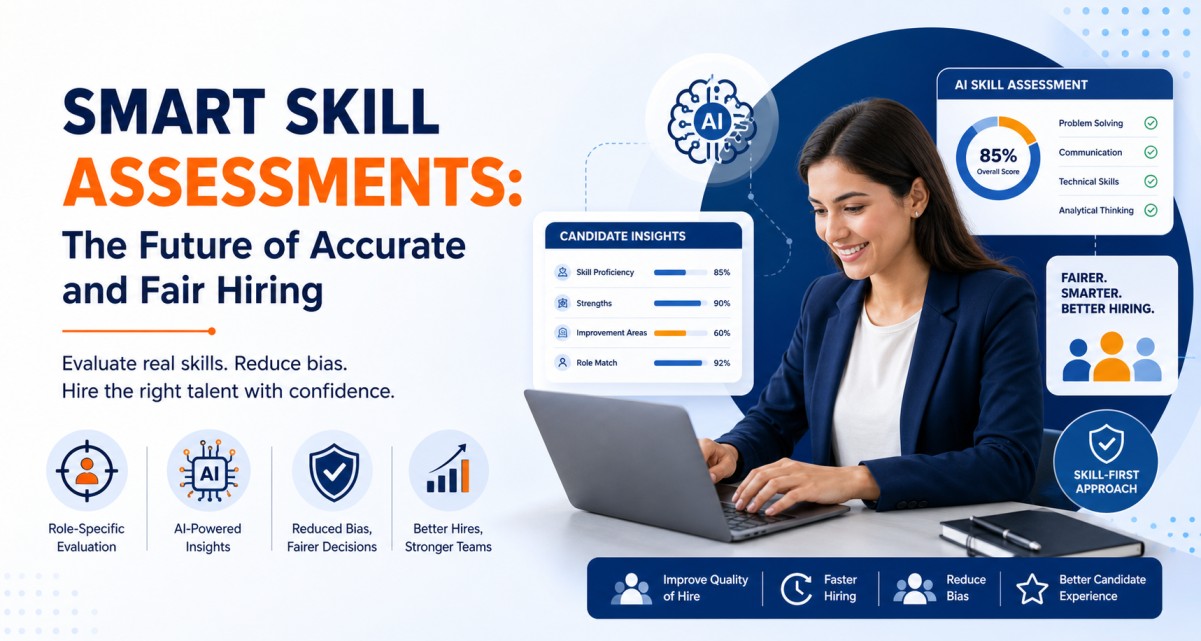
Smart Skill Assessments: The Future of Accurate and Fair Hiring
Hiring decisions are only as strong as the way candidates are evaluated.
Yet, many organizations still rely heavily on resumes, past job titles, and subjective interviews — signals that often fail to reflect a candidate’s actual capabilities.
As hiring becomes more complex and competitive, there is a clear shift toward skill-based evaluation.
This is where smart skill assessments are redefining how organizations identify, evaluate, and select talent.
What Are Smart Skill Assessments?
Smart skill assessments are AI-enabled evaluation tools designed to measure a candidate’s actual abilities, role readiness, and problem-solving skills.
Unlike traditional assessments that focus on theoretical knowledge or generic testing, smart assessments are:
- Context-driven
- Role-specific
- Data-informed
- Structured for consistency
They provide a more accurate understanding of whether a candidate can perform in the role — not just qualify for it on paper.
Why Traditional Hiring Assessments Fall Short
Many hiring processes still depend on outdated evaluation methods.
These approaches create gaps between candidate potential and hiring decisions
1. Over-Reliance on Resumes
Resumes highlight:
- Past roles
- Companies
- Educational background
But they often fail to show:
- Practical skill application
- Real-world problem-solving ability
- Learning agility
This leads to decisions based on signals, not evidence.
2. Generic Testing Methods
Standardized tests are often:
- Not aligned with specific roles
- Too theoretical
- Unable to reflect real job scenarios
As a result, they fail to predict on-the-job performance.
3. Subjective Interview Evaluations
Interviews, when unstructured, introduce:
- Inconsistent scoring
- Personal bias
- Variability across interviewers
This reduces reliability in hiring decisions.
How Smart Skill Assessments Improve Hiring Outcomes
Smart skill assessments address these gaps by introducing structure, relevance, and intelligence into candidate evaluation.
1. Role-Specific Skill Evaluation
Modern assessments are designed based on actual job requirements.
For example:
- A developer may solve real coding challenges
- A marketer may analyze campaign scenarios
- A recruiter may evaluate candidate profiles
This ensures alignment between assessment and role expectations.
2. Real-World Scenario Testing
Smart assessments simulate practical work situations.
This helps evaluate:
- Decision-making ability
- Problem-solving skills
- Application of knowledge
It shifts hiring from:
“What do you know?” → “What can you do?”
3. Data-Driven Candidate Insights
AI-powered assessments generate structured insights such as:
- Skill proficiency levels
- Strength areas
- Improvement gaps
- Comparative candidate analysis
These insights support objective and informed hiring decisions.
4. Consistency Across Evaluations
Every candidate is assessed using the same framework.
This ensures:
- Fair comparison
- Standardized scoring
- Reduced subjectivity
Consistency is critical for both fairness and accuracy.
The Role of AI in Smart Skill Assessments
AI enhances assessments by making them adaptive, scalable, and intelligent.
1. Adaptive Testing
AI can adjust question difficulty based on candidate responses.
This helps:
- Accurately measure skill levels
- Avoid under or over-evaluation
- Provide personalized assessment experiences
2. Automated Evaluation
AI reduces manual effort by:
- Scoring responses
- Analyzing performance patterns
- Ranking candidates objectively
This improves speed without compromising evaluation quality.
3. Skill Intelligence and Matching
AI systems can map candidate skills against role requirements.
This enables:
- Better candidate-role alignment
- Identification of transferable skills
- Improved shortlisting accuracy
Business Impact of Smart Skill Assessments
Organizations adopting skill-based evaluation models often see measurable improvements.
1. Improved Quality of Hire
Hiring based on actual skills increases the likelihood of:
- Better job performance
- Faster ramp-up time
- Stronger role alignment
2. Faster Hiring Decisions
Structured assessments reduce time spent on:
- Manual screening
- Multiple interview rounds
- Decision delays
3. Reduced Hiring Bias
Skill-based evaluation minimizes reliance on:
- Educational background
- Previous company names
- Personal impressions
This promotes fairer and more inclusive hiring practices.
4. Better Candidate Experience
Candidates benefit from:
- Transparent evaluation criteria
- Relevant assessments
- Fair opportunities to demonstrate skills
A structured process improves overall perception of the hiring experience.
Key Features to Look for in Smart Skill Assessment Platforms
Not all assessment tools deliver the same value.
HR leaders should look for:
1. Role-Based Assessment Design
Assessments should reflect real job responsibilities, not generic questions.
2. AI-Driven Evaluation Insights
Look for platforms that provide:
- Skill scoring
- Comparative analysis
- Actionable hiring insights
3. Integration with Hiring Workflows
Assessments should integrate seamlessly with:
- ATS platforms
- Candidate pipelines
- Interview processes
4. Structured and Bias-Aware Frameworks
Ensure the platform supports:
- Standardized evaluation
- Consistent scoring
- Fair candidate comparison
Common Misconceptions About Skill Assessments
Myth 1: Assessments Slow Down Hiring
Reality: Well-designed assessments actually speed up decision-making by reducing uncertainty.
Myth 2: Only Technical Roles Need Skill Tests
Reality: Every role — from sales to HR — can benefit from skill-based evaluation.
Myth 3: Experience Is Enough
Reality: Experience does not always reflect current capability.
Skills provide a more accurate measure of job readiness.
The Future of Hiring: Skill-First, Data-Driven, and Intelligent
The shift toward smart skill assessments reflects a broader transformation in hiring.
Organizations are moving from:
Resume-Based Hiring → Skill-Based Hiring
From:
Subjective Decisions → Data-Driven Evaluation
From:
Assumptions → Evidence
As hiring continues to evolve, organizations that prioritize skill intelligence will be better positioned to build high-performing teams.
Final Thoughts
Smart skill assessments are no longer optional — they are becoming essential for modern hiring.
They help organizations:
- Evaluate candidates more accurately
- Improve hiring consistency
- Reduce bias
- Make faster, more confident decisions
For HR leaders, the focus is shifting from who looks right on paper to who can actually perform in the role.
And that shift is redefining the future of recruitment.