hcm-admin, Author at People XM - Next Gen People Experience
25Mar

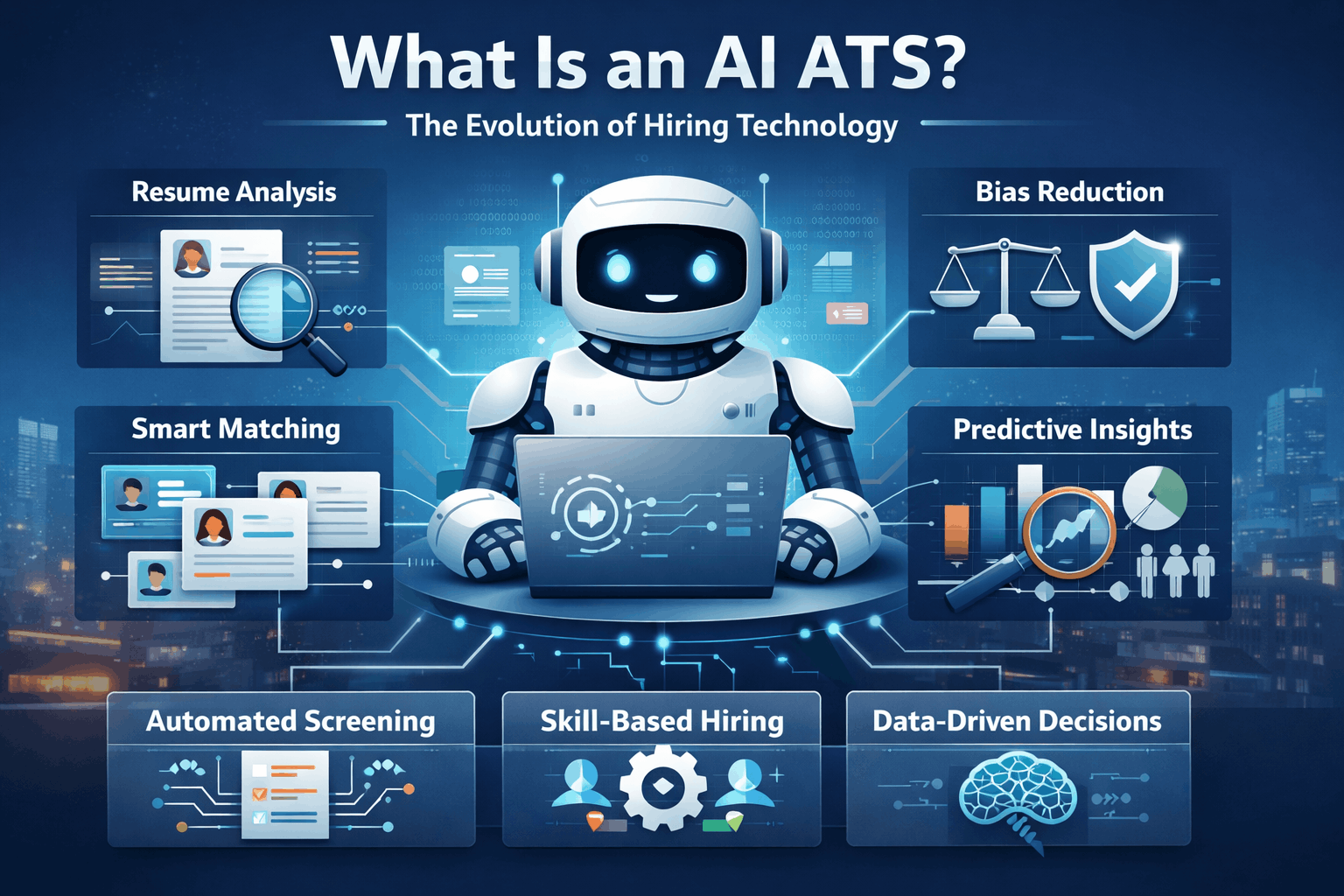
What Is an AI ATS and Why Modern Hiring Depends on It

What Is an AI ATS? A Complete Guide for Modern HR Leaders

Hiring today is no longer about collecting resumes — it’s about making faster, fairer, and more informed hiring decisions.

Traditional Applicant Tracking Systems (ATS) were designed to store resumes and manage workflows. But modern hiring demands more than tracking — it requires intelligence.

This is where an AI ATS (Artificial Intelligence Applicant Tracking System) changes the game.

In this guide, we’ll break down what an AI ATS is, how it works, why organizations are adopting it, and what HR leaders should look for when evaluating AI-powered hiring platforms.

What Is an AI ATS?

An AI ATS is an Applicant Tracking System enhanced with artificial intelligence that helps recruiters automate repetitive tasks, analyze candidate data intelligently, and make more accurate hiring decisions.

Unlike traditional ATS platforms that primarily store resumes and track candidate progress, an AI ATS actively interprets data, identifies patterns, and supports decision-making throughout the hiring lifecycle.

At its core, an AI ATS transforms recruitment from a process-driven workflow into a decision-driven system.

How Is an AI ATS Different From a Traditional ATS?

Many organizations assume their existing ATS is “AI-enabled,” but the difference between a traditional ATS and an AI ATS is significant.

Traditional ATS vs AI ATS: Key Differences

Capability Traditional ATS AI ATS
Resume Storage Stores resumes Understands resume context
Candidate Matching Keyword-based filtering Semantic and skill-based matching
Screening Manual-heavy Automated and intelligent
Decision Support Limited Data-driven recommendations
Bias Control Minimal Structured and bias-aware workflows
Speed Slower due to manual steps Faster through automation

Traditional ATS systems are built to manage hiring, while AI ATS platforms are built to optimize hiring outcomes.

This shift is especially critical for organizations handling large candidate volumes or hiring across multiple roles simultaneously.

How Does an AI ATS Work?

An AI ATS combines machine learning, natural language processing (NLP), and predictive analytics to support recruiters throughout the hiring process.

While implementations vary, most AI ATS platforms operate through several key layers.

1. Intelligent Resume Parsing

AI-powered systems automatically extract structured information from resumes such as:

  • Skills
  • Work experience
  • Certifications
  • Education
  • Career progression

More importantly, they understand context, not just keywords.

For example:

A traditional ATS may treat “Project Coordination” and “Project Management” as unrelated keywords.

An AI ATS recognizes their relationship and evaluates candidates accordingly.

2. Semantic Candidate Matching

Instead of matching resumes using simple keywords, AI ATS platforms use semantic matching.

This allows the system to:

  • Identify transferable skills
  • Recognize role relevance
  • Understand industry-specific terminology
  • Rank candidates based on skill fit

This reduces the risk of overlooking qualified candidates due to rigid keyword filters.

3. Automated Screening and Ranking

AI ATS platforms help recruiters focus on the most relevant candidates first.

Key capabilities include:

  • Shortlisting candidates based on role fit
  • Ranking applicants using skill alignment
  • Filtering large candidate pools
  • Reducing manual screening workload

This is particularly valuable in high-volume hiring environments where recruiters may receive hundreds — or thousands — of applications per role.


4. Predictive Hiring Insights

Advanced AI ATS platforms provide insights such as:

  • Candidate fit probability
  • Hiring pipeline bottlenecks
  • Time-to-hire predictions
  • Role success indicators

These insights shift hiring from reactive to strategic.


Why Organizations Are Moving to AI ATS Platforms

Hiring complexity has increased dramatically in recent years.

More applicants. More roles. More competition.

At the same time, HR teams are expected to deliver better hiring outcomes with fewer resources.

AI ATS platforms address these pressures directly.

1. Resume Volume Is Increasing Rapidly

Recruiters often face overwhelming volumes of resumes.

Manual screening at scale leads to:

  • Missed qualified candidates
  • Delayed hiring decisions
  • Recruiter fatigue
  • Inconsistent evaluations

AI ATS platforms help teams manage volume without sacrificing quality.

2. Speed Has Become a Competitive Advantage

Top candidates don’t stay available for long.

Organizations with slow hiring cycles often lose talent to faster competitors.

AI ATS platforms reduce delays by:

  • Automating screening
  • Prioritizing high-fit candidates
  • Streamlining decision workflows

This improves time-to-hire without reducing evaluation quality.

3. Hiring Quality Matters More Than Ever

Hiring mistakes are expensive.

Beyond salary costs, poor hires impact:

  • Team productivity
  • Manager bandwidth
  • Employee morale
  • Organizational performance

AI-driven decision support improves alignment between candidate capabilities and role expectations.


4. Fairness and Bias Reduction Are Strategic Priorities

Modern organizations are placing increased focus on fair and ethical hiring.

AI ATS platforms support structured evaluation processes that help:

  • Standardize candidate assessments
  • Reduce subjective decision-making
  • Promote consistency across hiring teams

Responsible AI design remains critical to ensuring fairness.


Key Features to Look for in an AI ATS

Not every ATS labeled “AI-powered” delivers meaningful intelligence.

HR leaders should evaluate capabilities carefully.

 1. True Semantic Matching (Not Just Keywords)

Look for systems that:

  • Understand skill relationships
  • Interpret experience context
  • Support role-based intelligence

Keyword filtering alone is not sufficient for modern hiring.

 2. Skill-Based Candidate Evaluation

Skill intelligence is becoming central to hiring success.

An effective AI ATS should:

  • Identify verified skills
  • Support skill-based hiring models
  • Enable structured comparisons between candidates

This shifts hiring focus from resumes to capabilities.

 3. Workflow Automation

Automation should reduce administrative workload, not remove recruiter judgment.

Look for:

  • Automated shortlisting
  • Interview scheduling support
  • Pipeline tracking automation

Recruiters should spend more time evaluating candidates — not managing spreadsheets.

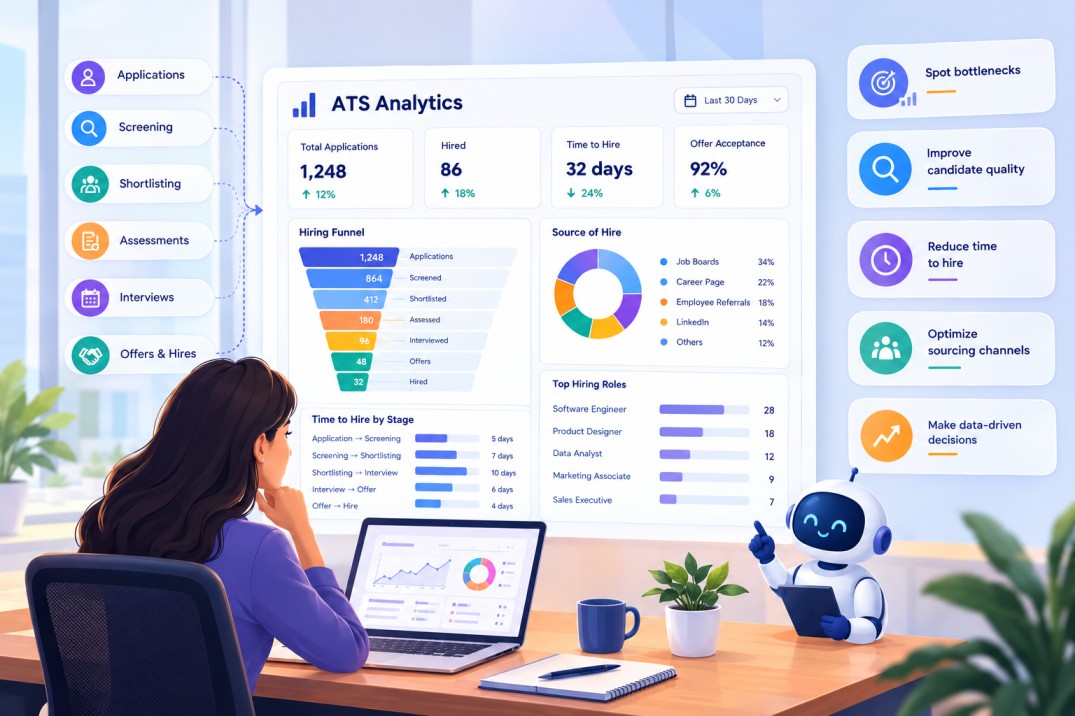
 4. Hiring Analytics and Decision Insights

Modern hiring requires visibility.

Strong AI ATS platforms provide:

  • Hiring funnel analytics
  • Drop-off insights
  • Time-to-hire metrics
  • Source performance tracking

These insights support continuous hiring improvement.

 5. Bias Awareness and Ethical AI Controls

Responsible hiring requires transparency.

Look for systems that:

  • Enable structured evaluations
  • Support standardized scoring
  • Promote fairness in decision-making

Ethical AI is not optional — it is foundational.

Common Misconceptions About AI ATS

Despite growing adoption, several misconceptions still exist.

 Myth 1: AI Replaces Recruiters

Reality: AI supports recruiters — it does not replace them.

Human judgment remains essential for:

  • Cultural alignment
  • Role nuance
  • Candidate engagement

AI handles repetitive work so recruiters can focus on meaningful evaluation.


Myth 2: AI ATS Is Only for Large Enterprises

Reality: Organizations of all sizes benefit from AI-driven hiring tools.

Any company managing:

  • High application volume
  • Multiple open roles
  • Distributed hiring teams

can benefit from AI-powered automation.


Myth 3: All ATS Platforms Have AI

Reality: Many systems market AI features without delivering real intelligence.

True AI ATS platforms demonstrate:

  • Measurable automation
  • Improved matching accuracy
  • Decision-support insights

Not just branding claims.

The Future of Hiring: From Tracking to Intelligence

The evolution from traditional ATS to AI ATS reflects a broader shift in hiring philosophy.

Recruitment is moving from:

Resume Management → Talent Intelligence

From:

Manual Screening → Intelligent Decision Support

From:

Process Efficiency → Hiring Effectiveness

Organizations that adopt AI-powered hiring tools are not simply modernizing software — they are redefining how hiring decisions are made.

Final Thoughts: Why AI ATS Is Becoming Essential

An AI ATS is no longer a futuristic concept — it is quickly becoming a practical necessity.

As hiring complexity continues to grow, organizations need systems that:

  • Reduce manual workload
  • Improve hiring speed
  • Support better decision-making
  • Promote fairness and consistency

AI-powered hiring platforms represent a natural evolution toward smarter, more reliable hiring outcomes.

For HR leaders, the real question is no longer whether AI will shape hiring, but how quickly organizations adapt to it.

09Feb

AI Recruiter vs Traditional Recruiter | What HR Leaders Must Know

AI Recruiter vs Traditional Recruiter: What HR Leaders Must Know

Recruitment is no longer just about filling roles—it’s about making consistent, fair, and high-quality hiring decisions at scale.

As hiring volumes increase and skill requirements evolve faster than job titles, HR leaders are increasingly evaluating a critical question:

Should recruitment continue to rely primarily on traditional recruiters, or should AI recruiters become a core part of the hiring model?

This article breaks down the reality of AI recruiter vs traditional recruiter, using structured comparison, ROI perspective, and expert commentary—so leaders can make informed, future-ready decisions.

Understanding the Two Models

Before comparing, it’s important to clarify what each model actually represents.

Traditional Recruiter

A human recruiter responsible for sourcing, screening, coordinating interviews, and managing candidate communication—largely through manual or semi-automated processes.

AI Recruiter

An AI-powered system embedded within an ATS that supports recruiters by automating screening, matching candidates to roles based on skills, prioritizing profiles, and generating hiring insights—while humans retain decision authority.

This is not about replacement. It’s about augmentation and scale.


AI Recruiter vs Traditional Recruiter: Side-by-Side Comparison

Hiring DimensionTraditional RecruiterAI Recruiter
Resume ScreeningManual review, keyword-basedSkill-aware, semantic matching
SpeedLimited by human capacityScales instantly with volume
ConsistencyVaries by recruiterStandardized evaluation logic
Bias RiskSubjective judgmentBias-reduction through structured data
Recruitment AutomationMinimalCore capability
Recruiter ProductivityCapped by timeMultiplied through automation
Decision SupportExperience-basedData + explainable insights
Cost EfficiencyIncreases with scaleImproves with scale

Key takeaway:
Traditional recruiters bring human judgment and context. AI recruiters bring speed, structure, and consistency. The future lies in combining both.


The ROI Lens: Why AI Recruiters Are Gaining Ground

While ROI varies by organization, enterprise hiring data consistently highlights where AI recruiters create measurable impact.

1. Time-to-Hire Reduction

AI recruiters automate early-stage screening and prioritization, helping teams focus only on relevant candidates.

Outcome: Faster shortlisting without sacrificing quality.


2. Improved Recruiter Productivity

Recruiters spend a significant portion of their time on repetitive tasks—resume screening, coordination, and status updates.

With recruitment automation:

  • One recruiter can manage significantly higher requisition loads

  • Time shifts from screening to stakeholder engagement and candidate experience

Outcome: Higher recruiter productivity without burnout.


3. Better Quality of Hire Signals

AI recruiters evaluate candidates against role-specific skills and competencies rather than surface-level indicators like keywords or employer names.

Outcome: More consistent shortlists and stronger role alignment.


4. Cost Efficiency at Scale

As hiring volume increases, traditional recruitment costs scale linearly with headcount. AI recruiters scale non-linearly.

Outcome: Lower marginal cost per hire in high-volume and enterprise hiring.


Expert Commentary: What HR Leaders Are Getting Wrong

A common misconception is viewing AI recruiters as a replacement for human recruiters.

In reality, the most effective organizations use AI recruiters to:

  • Eliminate low-value manual work

  • Bring structure to subjective decisions

  • Create consistency across teams and geographies

Where Traditional Recruiters Still Matter

  • Final hiring decisions

  • Cultural and team fit assessment

  • Candidate relationship management

  • Complex or niche roles

Where AI Recruiters Add Maximum Value

  • High-volume screening

  • Skill-based shortlisting

  • Reducing unconscious bias

  • Providing data-backed hiring insights

The future recruiter is not replaced—it is AI-enabled.


How PeopleXM Thinks About the AI Recruiter Model

At PeopleXM, we don’t believe in “full automation hiring.”

We believe in intelligent recruitment automation that supports human judgment.

Our AI recruiter capabilities are designed to:

  • Improve recruiter productivity without removing control

  • Enable skill-first hiring over resume heuristics

  • Provide explainable insights HR leaders can trust

  • Scale fairly, consistently, and ethically

The goal is not faster hiring alone—but better hiring decisions, repeated consistently.


Final Thought: Choosing Between AI and Traditional Recruiters Is the Wrong Question

The real question HR leaders should ask is:

“How do we design a hiring model where humans and AI work together—at enterprise scale, with fairness and intelligence?”

Organizations that answer this well will:

  • Hire better talent

  • Reduce hiring risk

  • Future-proof their recruitment function

And that is where the modern AI recruiter becomes a strategic advantage—not a replacement.

30Jan

Future of Hiring with AI ATS

The Future of Hiring: How AI ATS Is Redefining Recruitment

Hiring has entered a critical inflection point.

Enterprises today are hiring at scale, across geographies, skills, and evolving job roles—yet many recruitment processes still rely on legacy ATS systems built for resume storage, not hiring intelligence.

This gap between modern hiring demands and outdated recruitment infrastructure is where AI ATS and AI recruitment platforms are reshaping the future of talent acquisition.

This article explores how AI ATS is redefining recruitment through industry trends, expert insights, and PeopleXM’s vision for ethical, skill-based, and data-driven hiring.

Industry Trends: Why AI ATS Is Becoming the New Hiring Standard

1. From Resume Management to Hiring Intelligence

Traditional ATS platforms were designed to track applications, not evaluate talent. In contrast, modern AI ATS systems focus on:

  • Understanding candidate skills, not just keywords

  • Mapping role requirements to real-world competencies

  • Supporting better hiring decisions, not just faster workflows

This shift reflects a broader trend: recruitment is becoming a decision science, not an administrative function.


2. Rise of AI Recruitment in High-Volume & Enterprise Hiring

Organizations hiring hundreds or thousands of candidates annually face challenges such as:

  • Recruiter burnout

  • Long time-to-hire

  • Inconsistent screening quality

  • High drop-off rates

AI recruitment platforms enable automated hiring workflows that scale intelligently—screening, shortlisting, and ranking candidates based on skills, role fit, and potential, while keeping humans in control of final decisions.


3. Skill-Based Hiring Replacing Credential-Based Filters

Degrees, job titles, and brand-name companies are no longer reliable indicators of performance.

Talent acquisition AI is increasingly used to:

  • Assess job-relevant skills

  • Identify adjacent or transferable capabilities

  • Reduce bias caused by resume formatting or background signals

This shift is critical for building diverse, future-ready workforces.


4. Ethics, Fairness, and Explainable AI in Hiring

As AI ATS adoption grows, enterprises are demanding:

  • Transparent screening logic

  • Bias-reduction mechanisms

  • Compliance with evolving AI governance norms

The future of AI recruitment is not “black-box automation” but explainable, auditable, and ethical AI hiring systems.


Expert POV: What the Future of AI ATS Really Looks Like

From an enterprise hiring perspective, the future of AI ATS is defined by augmentation, not replacement.

AI will not replace recruiters—but it will redefine their role.

What AI ATS Should Do Well

  • Automate repetitive, low-value tasks

  • Surface high-quality, role-relevant candidates

  • Provide hiring insights recruiters can trust

  • Improve consistency and fairness at scale

What AI ATS Should Never Do

  • Make final hiring decisions without human oversight

  • Optimize purely for speed at the cost of quality

  • Introduce hidden bias through opaque algorithms

The most effective AI recruitment platforms act as decision partners—supporting recruiters with data, context, and intelligence.


PeopleXM’s Vision: Responsible AI ATS for the Next Decade of Hiring

At PeopleXM, we believe the future of hiring is built on three core principles:

1. Intelligence Over Automation

Automated hiring should not mean blind automation.

PeopleXM’s AI ATS is designed to:

  • Understand skills semantically, not superficially

  • Align candidate capabilities with real job outcomes

  • Support recruiter judgment with explainable insights


2. Fairness by Design

Bias reduction cannot be an afterthought.

Our approach to AI recruitment emphasizes:

  • Skill-first evaluations

  • Reduced dependency on demographic proxies

  • Structured, consistent screening across candidates

This enables organizations to scale hiring without compromising fairness or diversity goals.


3. Enterprise-Grade Decision Intelligence

Modern hiring leaders need answers—not dashboards full of noise.

PeopleXM focuses on:

  • Quality of hire indicators

  • Funnel diagnostics

  • Talent intelligence that informs workforce planning

This positions AI ATS as a strategic hiring layer, not just a transactional tool.


The Road Ahead: What the Future of AI Recruitment Means for HR Leaders

Over the next few years, organizations that succeed in hiring will be those that:

  • Move from legacy ATS to AI-driven hiring platforms

  • Embrace skill-based, data-informed recruitment

  • Balance automation with accountability

  • Treat hiring as a long-term capability, not a short-term process

AI ATS will not just redefine recruitment—it will redefine how organizations build teams, careers, and competitive advantage.


FAQs: AI ATS & the Future of Recruitment

1. What is an AI ATS?

An AI ATS (Artificial Intelligence Applicant Tracking System) uses machine learning and intelligence models to enhance resume screening, candidate matching, and hiring decision support beyond traditional ATS capabilities.


2. How is AI recruitment different from traditional hiring?

AI recruitment focuses on skills, patterns, and data-driven insights, whereas traditional hiring relies heavily on manual screening, keywords, and subjective evaluation.


3. Is automated hiring safe and ethical?

Automated hiring is safe when designed with transparency, human oversight, and bias-reduction mechanisms. Ethical AI ATS platforms prioritize explainability and fairness.


4. Can AI ATS help improve quality of hire?

Yes. By focusing on role-relevant skills and structured evaluation, AI ATS platforms help organizations consistently identify candidates with higher long-term success potential.


5. Will AI replace recruiters in the future?

No. AI will augment recruiters by handling repetitive tasks and providing insights—allowing recruiters to focus on human judgment, relationship-building, and strategic hiring decisions.

08Jan

How AI-Powered Psychometric Analysis Helps Recruiters Hire the Right Candidate the First Time

How AI-Powered Psychometric Analysis Helps Recruiters Hire the Right Candidate the First Time

Hiring the right candidate has become one of the biggest challenges for today’s recruiters. With rising application volumes, resume inflation, shorter hiring timelines, and increasing pressure to deliver quality hires, traditional recruitment methods often fall short. While resumes and interviews reveal what a candidate has done, they rarely predict how a candidate will perform once hired.

This is where AI-powered psychometric analysis is redefining recruitment—enabling organizations to move from assumption-based decisions to predictive, data-driven hiring.


The Challenges of Traditional Hiring

Most hiring processes continue to rely on:

  • Resume screening and keyword matching

  • Interviews influenced by intuition or perceived “culture fit”

  • Skill-based assessments alone

These methods have inherent limitations:

Resumes don’t reveal mindset or behavior
Two candidates with similar experience can perform very differently in real-world scenarios.

Interviews are vulnerable to bias
Unconscious bias, communication style, and likeability often influence decisions more than actual job suitability.

Skills alone don’t ensure success
Adaptability, emotional intelligence, decision-making, and collaboration play a crucial role in long-term performance—yet are rarely assessed.

The result is often misaligned hires, early attrition, low engagement, and increased rehiring costs.


What Is Psychometric Analysis in Recruitment?

Psychometric analysis evaluates a candidate’s cognitive abilities, personality traits, behavioral tendencies, and work style using scientifically validated assessments.

When enhanced with AI, psychometric analysis becomes significantly more powerful by:

  • Processing large candidate volumes efficiently

  • Benchmarking candidates against high performers

  • Predicting job success with greater accuracy

  • Delivering objective, bias-reduced insights


How AI Enhances Psychometric Assessments

AI does not replace psychometric science—it strengthens its effectiveness, scalability, and accuracy.

1. Predictive Hiring Instead of Reactive Hiring

AI analyzes historical hiring and performance data to identify patterns associated with success. Recruiters gain insights into whether a candidate is likely to:

  • Perform effectively in the role

  • Adapt to the organizational environment

  • Sustain long-term engagement

This enables hiring decisions based on future performance potential, not just past job titles.


2. Objective and Bias-Reduced Evaluation

AI-powered psychometric tools assess measurable traits such as:

  • Problem-solving ability

  • Emotional intelligence

  • Decision-making style

  • Stress tolerance

  • Collaboration and teamwork

By focusing on data rather than background, education, or communication style, AI supports fairer and more inclusive hiring.


3. Better Role Fit Beyond Skill Matching

Every role requires a unique combination of skills and behavioral traits:

  • Sales roles demand resilience and persuasion

  • Leadership roles require empathy and confident decision-making

  • Technical roles need analytical depth and sustained focus

AI maps psychometric profiles directly to role-specific success criteria, ensuring stronger alignment between candidates and job requirements.


4. Faster Hiring With Greater Confidence

AI-powered psychometric analysis automates candidate evaluation, enabling recruiters to:

  • Instantly identify best-fit candidates

  • Reduce manual screening efforts

  • Make confident decisions earlier in the hiring cycle

This significantly improves time-to-hire without compromising quality.


Why Hiring the Right Candidate the First Time Matters

A bad hire can cost organizations 30–50% of an employee’s annual salary, factoring in:

  • Recruitment expenses

  • Onboarding and training costs

  • Lost productivity

  • Team disruption and morale impact

AI-powered psychometric analysis helps organizations:

  • Reduce early attrition

  • Improve employee performance

  • Increase engagement and retention

  • Build consistently high-performing teams

Hiring right the first time is no longer optional—it’s a strategic necessity.


How PeopleXM Enables Smarter Hiring

PeopleXM seamlessly integrates AI-driven psychometric analysis into the recruitment workflow, allowing recruiters to:

  • Evaluate candidates beyond resumes

  • Match psychometric traits with job requirements

  • Combine skill assessments with behavioral intelligence

  • Make faster, more accurate, and confident hiring decisions

By assessing both capability and mindset, PeopleXM ensures recruiters don’t just hire qualified candidates—they hire the right candidates.


The Future of Recruitment Is Predictive

Recruitment is rapidly evolving from intuition-based decisions to evidence-based hiring. Organizations that adopt AI-powered psychometric analysis gain a clear competitive advantage through:

  • Higher workforce quality

  • Lower hiring risk

  • Stronger long-term ROI


Schedule a free demo today and see how PeopleXM can transform your hiring process.
29Oct

Recruit Smarter, Not Harder: How PeopleXM Makes Talent Rediscovery Effortless

Recruit Smarter, Not Harder: How PeopleXM Makes Talent Rediscovery Effortless

The Recruiter’s Reality: Lost Talent, Lost Time

Recruiters spend endless hours searching for the right candidates—filtering resumes, shortlisting, and re-evaluating profiles that may already exist in their database.
It’s a cycle that costs time, effort, and often, great talent that gets overlooked.

Imagine this:
You sourced hundreds of candidate’s last quarter. Some were almost the perfect fit but didn’t make the final cut. Now, when a new role opens, those same candidates could be ideal—but they’re buried in your inbox or old ATS folders.

That’s where the real loss happens — you’ve already sourced the right people but can’t find them again.

The Before: Manual Resume Mining

Before AI-driven tools like PeopleXM, recruiters relied on manual searches through old folders, Excel sheets, or ATS databases.
Even if you found potential matches, it took hours to check if their skills aligned with the new JD.

Challenges faced:

  • Wasted hours re-screening old resumes
  • Missed out on qualified candidates already in your system
  • Increased cost per hire
  • Slower time-to-fill

Manual rediscovery was like searching for a needle in a haystack — and the haystack just kept growing.

The After: AI-Powered Talent Rediscovery

Now, with PeopleXM’s AI-driven Talent Rediscovery, recruiters can simply upload their existing resume database, define a job description, and let the system do the heavy lifting.

Here’s how PeopleXM transforms the process:

  1. AI Resume Parsing: Instantly scans and categorizes every resume in your database.
  2. Smart JD Matching: Automatically matches candidate skills, experience, and job relevance to your open role.
  3. Instant Ranking: Displays top-fit candidates — no manual search, no guesswork.

Within seconds, you rediscover hidden gems already in your system — candidates who are ready, relevant, and previously vetted.

Mini Use Case: From Manual Chaos to AI Clarity

Before PeopleXM:
Recruiter A at a growing tech firm spent 8–10 hours per week manually searching through resumes to fill niche roles. Many resumes were duplicates or outdated, leading to frustration and missed deadlines.

After PeopleXM:
Using AI-powered rediscovery, the recruiter uploaded over 2,000 resumes, created the JD, and received top 10 matched candidates in under a minute.
The team re-engaged 3 previously sourced candidates and filled the role 5x faster, with zero additional sourcing cost.

Result:

  • Time-to-hire reduced by 60%
  • Cost-per-hire reduced by 40%
  • Recruiter productivity up by 3x

The ROI of Smarter Recruiting

Recruiting smarter isn’t about adding more tools — it’s about unlocking the full potential of what you already have.
With PeopleXM, every resume you’ve ever sourced becomes part of a living, searchable, AI-optimized talent ecosystem.

Key benefits:

  • Reduce sourcing costs with rediscovery
  • Improve recruiter efficiency
  • Build long-term candidate relationships
  • Hire faster with precision

Conclusion: Your Next Great Hire Might Already Be in Your Database

The future of recruiting isn’t about working harder — it’s about working smarter.
PeopleXM helps you rediscover top talent effortlessly, maximize your existing data, and transform recruiting into a fast, intelligent, and ROI-driven process.

👉 Ready to rediscover your hidden talent pool?
[Book a demo today with PeopleXM.]
21Aug

The Real Cost of a Bad Hire – and How PeopleXM Helps You Avoid It

The Real Cost of a Bad Hire – and How PeopleXM Helps You Avoid It

Bad hires don’t just hurt your budget—they impact morale, productivity, and your brand. Learn how PeopleXM’s AI-powered hiring platform helps you make smarter, faster, and better hiring decisions.

Every hiring manager has been there—someone looked perfect on paper, aced the interview, but turned out to be a mismatch. The result? Wasted time, lost money, and a team left picking up the slack.

Bad hires are more than just a temporary inconvenience—they’re costly, disruptive, and surprisingly common. According to the U.S. Department of Labor, a bad hire can cost up to 30% of an employee’s first-year earnings.

In this article, we’ll break down the hidden costs of a bad hire and show how PeopleXM helps companies hire smarter and avoid expensive mistakes.

💸 The Hidden Costs of a Bad Hire

  1. Financial Drain
    From onboarding and training to salary and benefits, the investment in a new hire is significant. When the hire doesn’t work out, all of these costs are lost—and the replacement process starts all over again.
  2. Productivity Loss

    Bad hires slow down projects, distract managers, and cause deadlines to slip. The ripple effect can impact an entire team’s output.
  3. Morale and Culture Impact

    A poor fit can create tension, reduce team morale, and even push top-performing employees to leave. This makes the real cost far higher than just lost salary.
  4. Client Experience & Brand Reputation

    In client-facing roles, the wrong hire can damage relationships, harm your reputation, and erode customer trust.

🤖 Why Do Bad Hires Happen?

Most bad hires aren’t the result of laziness—they happen because of flawed hiring processes:

  • Overreliance on resumes and keyword searches
  • Rushed hiring timelines with limited screening
  • Lack of data on soft skills and culture fit

Traditional hiring tools often miss the bigger picture. This is where PeopleXM makes the difference.

How PeopleXM Prevents Bad Hires

PeopleXM is an AI-powered hiring platform designed for modern HR teams and recruiters. Here’s how it reduces bad hires:

  • AI-Powered Shortlisting – Goes beyond resumes by evaluating skills, behavior, and fit-for-role criteria.
  • Culture Fit & Behavioral Scoring – Matches candidates not just to the role, but to your company culture.
  • Automated Screening & Scheduling – Saves time by ensuring only qualified candidates move forward.
  • Real-Time Insights & Reporting – Supports hiring decisions with data, not guesswork.

🚀 The Results?

Companies using PeopleXM report:

  • 50% reduction in time-to-hire
  • Higher employee retention rates
  • Improved candidate satisfaction scores
  • More confident hiring decisions

🔍 Conclusion

Bad hires are costly—but they’re preventable. With the right tools and insights, your hiring process can become a competitive advantage.

PeopleXM helps you hire smarter, faster, and better—so you can build high-performing teams that last.

👉 Ready to avoid your next bad hire?
Schedule a free demo today and see how PeopleXM can transform your hiring process.

17Jul

Why AI Is the Future of Hiring: How Recruiters Can Save Time and Hire Smarter

Why AI Is the Future of Hiring: How Recruiters Can Save Time and Hire Smarter

AI Future Hiring

The Hiring Process Is Broken.

Manual screening, generic assessments, and gut-feeling decisions are no longer enough. Traditional hiring methods are slow, biased, and often result in poor matches — costing companies time, money, and talent. In today’s fast-moving job market, recruiters need smarter, faster, and more reliable solutions.

That’s where PeopleXM comes in.

Meet the New Age of Hiring: Powered by AI

At PeopleXM, we believe the future of hiring lies in data, automation, and intelligence — not guesswork. Our AI-powered platform is designed to help companies screen, assess, and select candidates with precision and speed.

Here’s how we’re changing the game:

Auto-Screen Resumes in Seconds

Manually sorting through hundreds of resumes? Not anymore.
PeopleXM’s AI scans resumes in real time, identifies key skills and experience, and ranks candidates based on their fit with the job role. You get a shortlist of top matches — instantly.

Match Job Descriptions with Candidate Profiles

Our platform reads your job description and aligns it with each candidate’s background.
We use smart algorithms to calculate a match score, so recruiters can focus only on the most relevant applicants — saving hours of manual comparison.

Create Auto-Graded Skill Assessments

No more one-size-fits-all tests.
PeopleXM creates customized, auto-graded assessments based on your specific job requirements. Whether it’s technical skills or soft skills, you can evaluate candidates objectively and instantly.

Say Goodbye to Manual Shortlisting

With AI doing the heavy lifting, recruiters no longer have to waste time scanning irrelevant resumes or struggling to make subjective decisions. PeopleXM ensures every candidate is evaluated fairly and consistently.

Say Hello to Data-Driven Hiring

Hiring decisions should be based on evidence — not instincts.
PeopleXM provides detailed analytics, performance breakdowns, and candidate match scores to help you hire with confidence, accuracy, and speed.

The Bottom Line

AI is not just the future of hiring — it’s the present.
Companies that adopt AI-driven tools are seeing faster hiring cycles, better candidate quality, and more diverse teams. At PeopleXM, we’re proud to power that transformation.

Ready to Hire Smarter?

Let PeopleXM help you build the future of your workforce.


16Jul

Why Outsourcing Staff Is the Smartest Move for Growing Businesses

Why Outsourcing Staff Is the Smartest Move for Growing Business?

In today’s competitive market, companies are under pressure to scale fast, stay lean, and deliver exceptional results. But building an in-house team for every function is time-consuming, expensive, and often impractical. That’s where PeopleXM steps in.

As a leading staff outsourcing partner, PeopleXM enables businesses to stay agile, efficient, and focused on what they do best—growing their core business.

What is Staff Outsourcing?

Staff outsourcing is a strategic business practice where companies delegate specific roles or departments to an external provider. It could range from IT support and customer service to field sales teams, admin professionals, or project-based consultants.

Instead of hiring, training, and managing employees in-house, you tap into a ready-to-deploy talent pool—tailored to your needs.

Why More Businesses Are Turning to PeopleXM for Staffing Solutions

Faster Hiring, Better Talent
PeopleXM has a pre-vetted pool of qualified professionals ready to join your team. We reduce hiring timelines from months to days.

Cost-Effective Operations
Forget overheads, training expenses, and employee liabilities. You only pay for what you need.

Scalable Staffing
Need 10 people today and 50 next quarter? No problem. We scale your team up (or down) based on real-time business needs.

Focus on Core Business
Free up your internal teams to focus on strategy, product, and revenue while we handle the staffing.

Pan-India & Global Reach
Whether you’re expanding across cities or into new markets, our talent network ensures you’re covered.

Popular Roles We Help You Fill

  • Sales Executives & Field Force

  • Customer Support & Telecalling Teams

  • Back-office & Data Entry Professionals

  • Warehouse & Logistics Staff

  • On-ground Event Staff & Promoters

  • Technical Support Agents

Real Results. Real Impact.

PeopleXM has helped businesses across sectors—retail, healthcare, fintech, logistics, and more—optimize their workforce, improve productivity, and reduce operational costs by up to 40%.

Ready to Outsource with Confidence?

Whether you’re a startup scaling fast or a large enterprise needing reliable staffing support, PeopleXM is your trusted partner in workforce outsourcing. We don’t just place people—we build performance-driven teams that deliver.