Choosing the Right AI ATS: A Guide for HR Leaders | PeopleXM
Learn how to choose the right AI-powered Applicant Tracking System. Explore essential features, AI screening, candidate matching, skill assessments, analytics, and key factors to evaluate before investing in an ATS.
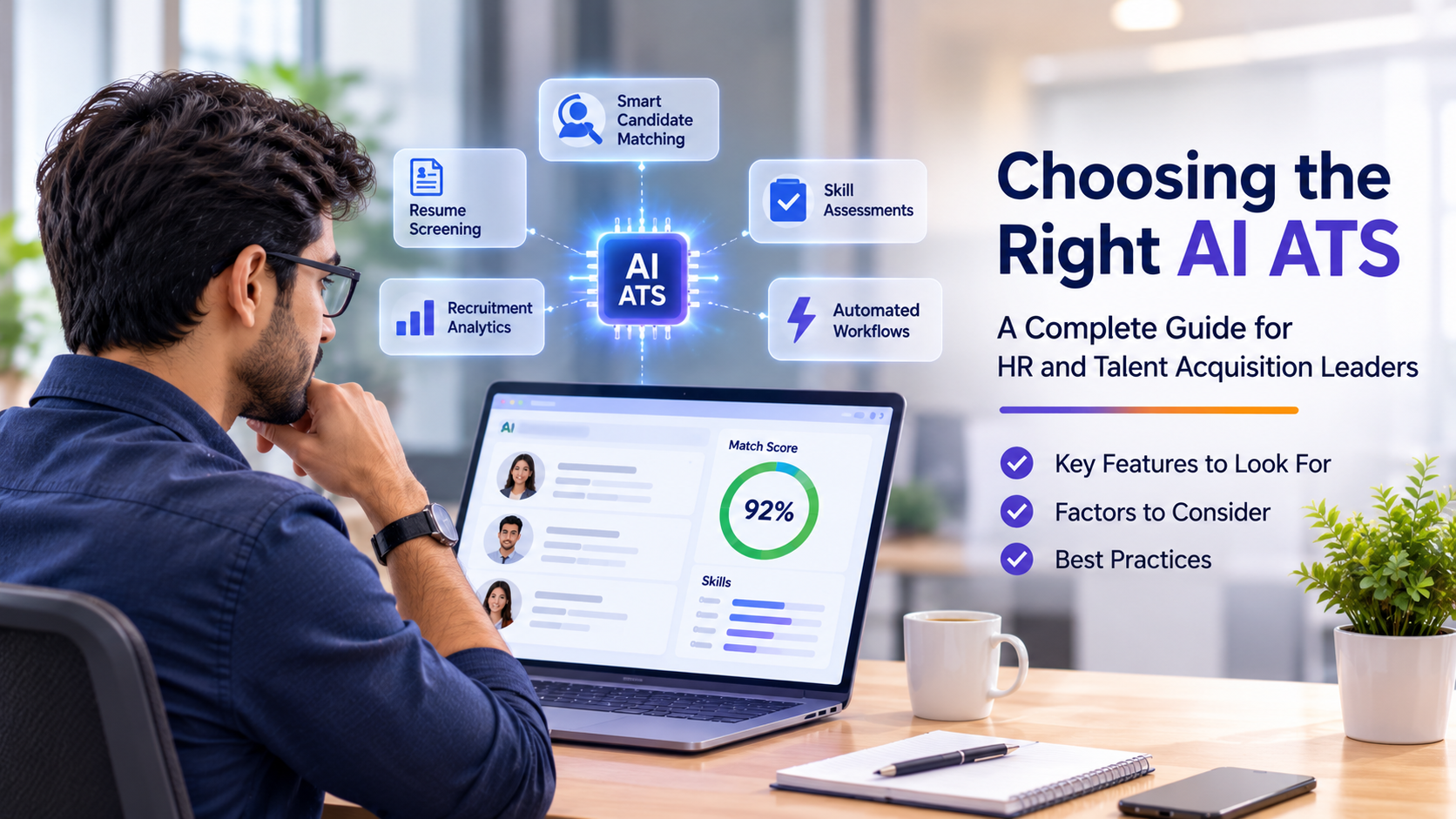
Choosing the Right AI ATS: A Complete Guide for HR and Talent Acquisition Leaders
Recruitment has become increasingly complex.
HR teams are expected to manage growing candidate volumes, reduce time-to-hire, improve candidate experience, and identify the right talent while maintaining consistency throughout the hiring process.
Traditional recruitment methods can make these responsibilities difficult to manage. Reviewing hundreds of resumes manually, tracking candidates across spreadsheets, coordinating interviews, and maintaining recruitment reports can consume valuable time.
This is why organizations are increasingly exploring AI-powered Applicant Tracking Systems (ATS).
However, choosing an AI ATS is not simply about selecting software with the most features. It is about finding a recruitment platform that understands your hiring requirements, supports your team's workflow, and helps improve the quality of hiring decisions.
The right system should do more than store resumes. It should help recruiters identify relevant candidates, evaluate skills, organize recruitment activities, and make better-informed decisions.
In this guide, we explore the important factors HR and Talent Acquisition leaders should consider when choosing the right AI ATS for their organization.
What Is an AI ATS?
An Applicant Tracking System (ATS) is software that helps organizations manage recruitment activities, from receiving applications to tracking candidates through different hiring stages.
An AI-powered ATS builds on these capabilities by using artificial intelligence to assist with tasks such as:
- Resume screening and analysis.
- Job description-based candidate matching.
- Candidate prioritization.
- Skills identification.
- Recruitment workflow automation.
- Candidate evaluation.
- Recruitment analytics and reporting.
Rather than relying entirely on manual resume reviews and administrative processes, recruiters can use AI-assisted capabilities to organize candidate information and focus their attention on relevant profiles.
The objective is not to remove recruiters from the hiring process. It is to give them better tools to manage recruitment more efficiently.
Why Choosing the Right AI ATS Matters
An ATS can influence several aspects of the recruitment process.
A poorly selected system may create additional administrative work, offer limited visibility into recruitment performance, or fail to support the organization's actual hiring requirements.
The right platform can help address common recruitment challenges.
1. Managing Large Volumes of Applications
Organizations hiring for multiple positions may receive hundreds or thousands of applications.
Manually reviewing every resume can slow down the screening process.
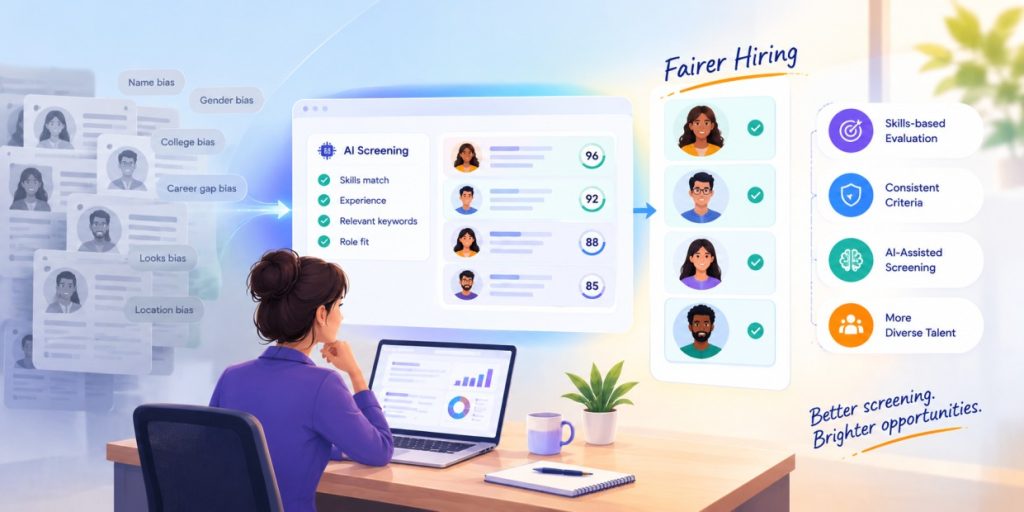
AI-assisted resume screening can help recruiters identify candidates whose skills and experience are relevant to the job requirements.
2. Improving Candidate Matching
A candidate may possess relevant skills without using the exact keywords mentioned in a job description.
A capable AI matching system can help identify relationships between job requirements and candidate profiles beyond basic keyword comparisons.
3. Reducing Repetitive Recruitment Work
Recruiters often spend significant time organizing applications, updating candidate statuses, coordinating activities, and preparing reports.
Automation can reduce repetitive administrative tasks and allow recruiters to spend more time on candidate engagement and evaluation.
4. Making Recruitment More Data-Informed
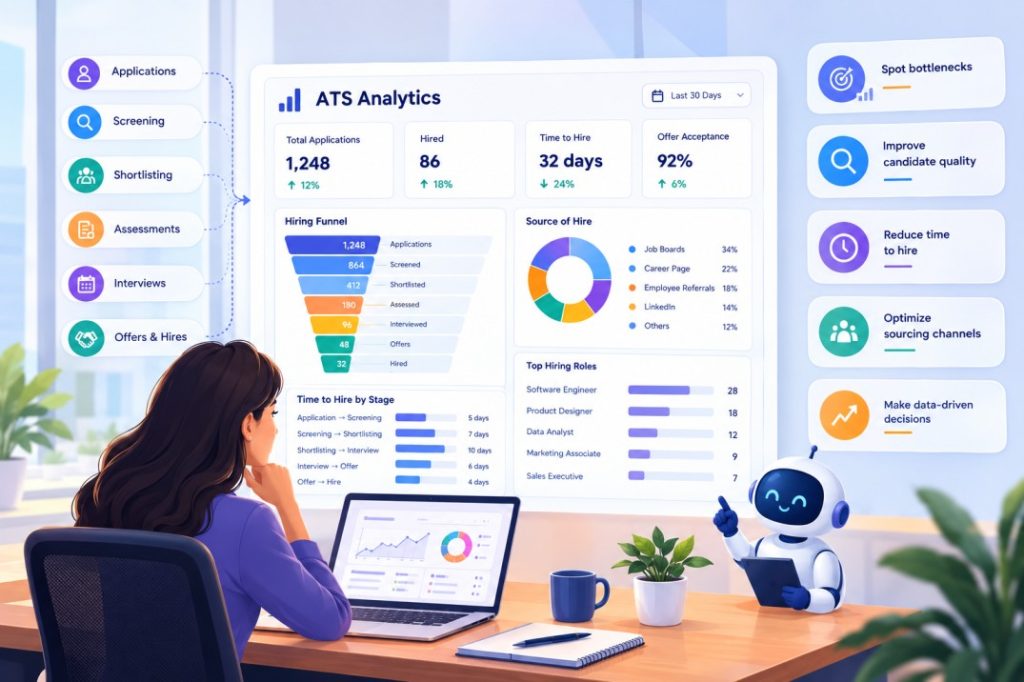
Without centralized recruitment data, it can be difficult to understand where candidates are dropping out, which sourcing channels are working, or which recruitment stages need improvement.
ATS analytics can help HR teams identify these patterns and make more informed decisions.
5. Creating a Better Candidate Experience
Delayed communication, unclear recruitment stages, and repetitive application processes can negatively affect candidate experience.
A well-designed ATS can help recruitment teams manage candidate information and workflows more consistently.
10 Essential Features to Look for When Choosing an AI ATS
Not every ATS offers the same capabilities. Before selecting a platform, organizations should evaluate whether its features address their specific recruitment challenges.
1. AI-Powered Resume Screening
Resume screening is one of the most important areas to evaluate.
A good AI ATS should help recruiters analyze candidate profiles against relevant job requirements.
Look for capabilities such as:
- Resume parsing and information extraction.
- Identification of relevant skills and experience.
- Candidate matching against job descriptions.
- Screening support for large application volumes.
- Easy access to candidate profiles and evaluation details.
The objective should be to reduce repetitive manual screening while keeping recruiters involved in evaluating candidates.
2. Job Description-Based Candidate Matching
A recruitment platform should help connect candidate capabilities with the requirements of a particular position.
AI-powered matching can help identify relevant skills, experience, and qualifications within candidate profiles.
For example, when hiring a Data Analyst, the system should help recruiters identify candidates with relevant experience in SQL, Python, data visualization, analytical thinking, and other role-specific requirements.
The matching process should be relevant to the position rather than based entirely on the number of keywords appearing in a resume.
3. Bulk Resume Upload and Processing
High-volume recruitment often involves handling large candidate databases.
Uploading and reviewing profiles individually can create unnecessary delays.
A useful AI ATS should support bulk resume processing and help recruiters organize candidate information efficiently.
This becomes particularly valuable when hiring for multiple departments, locations, or similar positions.
4. Skill Assessment Integration
A resume provides information about a candidate's background, but it may not fully demonstrate their practical capabilities.
Skill assessments can provide additional evidence of a candidate's knowledge and competencies.
Look for an ATS that supports or integrates relevant assessments, allowing organizations to evaluate candidates based on the requirements of the role.
For example:
- Technical assessments for engineering positions.
- Analytical assessments for data-related roles.
- Communication assessments for customer-facing positions.
- Aptitude assessments for entry-level recruitment.
Combining resume screening with relevant assessments can provide a broader understanding of candidate suitability.
5. Automated Recruitment Workflows
Recruitment involves several stages, including application review, shortlisting, assessments, interviews, and final selection.
An AI ATS should help organize these activities and reduce repetitive coordination.
Evaluate whether the system supports:
- Candidate stage tracking.
- Assessment initiation.
- Interview coordination.
- Recruitment status updates.
- Workflow automation.
- Centralized candidate records.
Automation should make recruitment easier to manage without making the process unnecessarily complicated.
6. Candidate Database and Talent Rediscovery
Organizations often receive applications from candidates who may not be suitable for an immediate opening but could be relevant for future opportunities.
An ATS should help recruiters organize and search their existing candidate database.
Talent rediscovery capabilities can help identify previously received profiles that match new job requirements.
This allows organizations to make better use of their existing talent pool instead of relying exclusively on fresh sourcing.
7. Recruitment Analytics and Reporting
Recruitment performance should be measurable.
An effective ATS should help HR teams understand how their recruitment process is performing.
Useful analytics may include:
- Total applications received.
- Candidates screened and shortlisted.
- Candidate conversion rates.
- Time-to-hire.
- Source-of-hire performance.
- Recruitment funnel progress.
- Assessment results.
- Position-wise hiring performance.
These insights can help recruitment leaders identify bottlenecks, evaluate processes, and improve hiring strategies.
8. Candidate Evaluation and Scoring
Candidate evaluation should go beyond resume presentation.
Look for systems that help recruiters organize relevant candidate information, assessment results, and evaluation criteria.
Structured evaluation can improve consistency when comparing candidates for similar positions.
However, AI-generated scores should be explainable and reviewed by people. They should support decisions rather than automatically determine who gets hired.
9. Ease of Use and Recruiter Experience
Even a feature-rich platform can become difficult to use if its interface is complicated.
Recruiters should be able to navigate the system, access candidate profiles, understand recruitment stages, and complete routine activities without unnecessary effort.
Before selecting an ATS, evaluate:
- User interface and navigation.
- Candidate search experience.
- Dashboard accessibility.
- Ease of creating job openings.
- Reporting experience.
- Training and onboarding requirements.
A platform should simplify recruitment workflows rather than introduce additional complexity.
10. Scalability, Security, and Integration
An ATS should support the organization's current hiring needs while accommodating future growth.
Before making a decision, consider:
- Ability to handle growing application volumes.
- Support for multiple recruiters and hiring teams.
- Data security and access controls.
- Data retention and privacy practices.
- Integration with existing HR systems.
- Availability of implementation and support services.
- Pricing as recruitment requirements expand.
These factors are particularly important for organizations managing multiple hiring locations, departments, or business units.
Traditional ATS vs. AI-Powered ATS
The difference between a traditional ATS and an AI-powered ATS lies in the level of assistance available throughout recruitment.
| Traditional ATS | AI-Powered ATS |
|---|---|
| Primarily organizes applications and candidate records | Adds AI-assisted candidate analysis and matching |
| Recruiters may manually compare resumes with job requirements | AI can help identify relevant skills and experience |
| Candidate searches may depend on predefined filters and keywords | AI-assisted matching can consider broader contextual relevance |
| Reporting often focuses on recruitment activity | Analytics can provide additional insights into recruitment performance |
| Recruiters coordinate many repetitive activities manually | Automation can support selected recruitment workflows |
| Candidate evaluation may rely heavily on manually collected information | Assessments and structured candidate insights can provide additional evidence |
An AI ATS does not eliminate the need for recruiters. It expands the tools available to support recruitment activities and decision-making.
How to Choose an AI ATS Based on Your Hiring Requirements
The best ATS for one organization may not be the right choice for another.
Hiring requirements vary depending on business size, recruitment volume, industry, role complexity, and available resources.
Here are some considerations for different hiring environments.
For Startups and Growing Businesses
Growing organizations may need an ATS that is easy to implement and manage.
Prioritize:
- Simple recruitment workflows.
- Resume screening.
- Job description-based matching.
- Candidate database management.
- Essential recruitment reporting.
For Enterprises
Large organizations often manage multiple recruitment teams, departments, locations, and hiring requirements.
Prioritize:
- High-volume resume processing.
- Role-based access controls.
- Recruitment analytics.
- Workflow automation.
- Scalability.
- Data security and integration capabilities.
For Recruitment Agencies
Agencies often handle multiple clients and job openings simultaneously.
Prioritize:
- Candidate database management.
- Fast candidate search and matching.
- Bulk resume processing.
- Multiple job tracking.
- Candidate evaluation.
- Talent rediscovery.
For High-Volume Hiring Teams
Organizations hiring large numbers of employees may need to process applications quickly while maintaining consistent evaluation criteria.
Prioritize:
- Bulk resume uploads.
- AI-assisted screening.
- Job-based candidate matching.
- Automated assessments.
- Candidate prioritization.
- Recruitment funnel analytics.
The important point is to choose a system based on actual hiring requirements rather than purchasing features that your team may never use.
Questions to Ask Before Investing in an AI ATS
Before finalizing a recruitment platform, HR leaders should ask vendors practical questions.
- How does the AI screening process work?
- Can the system match candidates against specific job descriptions?
- Does it support bulk resume uploads?
- Can it identify relevant skills beyond exact keyword matches?
- Are skill assessments available or integrated?
- Can recruiters review and understand candidate matching results?
- Does the platform support talent rediscovery?
- What recruitment analytics and reports are available?
- How does the platform protect candidate information?
- Can the system scale as hiring requirements increase?
- What implementation, onboarding, and support services are provided?
- How is pricing structured, and what features are included?
Requesting a product demonstration is also important.
Ask the vendor to demonstrate your actual recruitment workflow rather than showing only a standard feature presentation.
Common Mistakes to Avoid When Choosing an AI ATS
Selecting recruitment software without evaluating the organization's needs can lead to poor adoption and unnecessary costs.
Avoid these common mistakes.
Choosing Based Only on Price
The lowest-priced platform may not offer the capabilities your recruitment team needs.
Evaluate the overall value, including functionality, usability, scalability, support, and implementation requirements.
Assuming More AI Means Better Recruitment
AI features should solve actual recruitment problems.
A platform with many AI-related features is not automatically better than one that addresses your specific requirements effectively.
Ignoring Recruiter Feedback
Recruiters are the people who will use the platform regularly.
Involve them in the evaluation process and understand their current challenges before selecting a system.
Overlooking Candidate Experience
An ATS should improve the recruitment process for both recruiters and candidates.
Consider whether the system supports a clear, organized, and accessible candidate journey.
Ignoring Responsible AI Practices
Ask how candidate data is used, how recommendations are generated, and what human oversight is available.
Responsible implementation should be part of the selection process from the beginning.
Not Testing the Platform
A product demonstration or trial can help identify practical limitations that may not be obvious from a feature list.
Test the platform using realistic job descriptions, candidate profiles, and recruitment scenarios.
How PeopleXM Helps Organizations Modernize Recruitment
PeopleXM is an AI-powered hiring platform designed to help organizations make recruitment more structured, efficient, and skills-focused.
It brings together ATS capabilities and candidate assessment tools to support different stages of the hiring process.
Here is how PeopleXM can support recruitment teams.
AI-Powered Resume Screening
PeopleXM helps recruiters process candidate profiles and identify relevant information for screening.
This can reduce the effort involved in manually reviewing large numbers of applications.
JD-Based AI Candidate Matching
Recruiters can use job description-based matching to identify candidates whose skills and experience align with the requirements of an open position.
This supports a more structured approach to candidate shortlisting.
Bulk Resume Upload
PeopleXM supports bulk resume uploads, helping recruitment teams manage candidate information more efficiently when handling multiple applications.
Automated Assessment Initiation
Recruitment teams can streamline parts of the screening workflow by initiating assessments for shortlisted candidates.
This helps connect resume-based screening with skill evaluation.
Skill Assessments and Proctoring
PeopleXM provides skill assessment capabilities that help organizations evaluate candidate competencies.
Proctoring and assessment integrity features can support more controlled online assessment processes.
Talent Rediscovery
Recruiters can make use of their existing resume database to identify potentially relevant candidates for new job openings.
This can help reduce dependence on fresh sourcing for every requirement.
AI Psychometric Analysis
PeopleXM also offers AI-supported psychometric analysis as an additional source of candidate insights.
Such insights should be interpreted appropriately and alongside job-relevant evidence, assessments, and human evaluation.
Recruitment Analytics
Recruitment teams can use analytics to gain visibility into hiring activities and make more informed decisions.
Together, these capabilities help PeopleXM support a recruitment approach that combines AI-assisted screening, skill evaluation, and hiring intelligence.
Explore PeopleXM: https://peoplexm.ai/
A Practical Checklist for Selecting the Right AI ATS
Before making your final decision, use this checklist to evaluate potential platforms.
- Does it support AI-powered resume screening?
- Can it match candidates against job descriptions?
- Does it support bulk resume uploads?
- Can it help automate assessment workflows?
- Does it offer relevant skill assessment capabilities?
- Can recruiters search and rediscover existing candidates?
- Does it provide useful recruitment analytics?
- Is the platform easy for recruiters to use?
- Does it provide appropriate data security and access controls?
- Can it scale with future hiring requirements?
- Are implementation, training, and support available?
- Does the pricing align with the organization's budget and expected usage?
Use the checklist to compare vendors based on your actual priorities.
Conclusion: Choose an AI ATS That Supports Better Hiring Decisions
Choosing the right AI ATS is an important decision for any organization looking to modernize its recruitment process.
The right platform should do more than collect resumes and track applications. It should help recruiters identify relevant talent, evaluate skills, organize workflows, and understand recruitment performance.
AI-powered resume screening, job description-based matching, skill assessments, workflow automation, talent rediscovery, and recruitment analytics can all contribute to a more structured hiring process.
However, technology alone does not guarantee better hiring outcomes.
Organizations must also consider recruiter experience, candidate experience, data security, responsible AI practices, and the ability to adapt the platform to changing recruitment requirements.
The best AI ATS is not necessarily the one with the most features. It is the one that helps your organization find, evaluate, and engage the right talent more effectively.
As recruitment continues to evolve, choosing a platform that combines AI assistance with meaningful candidate evaluation and human judgment can help organizations build a stronger foundation for future hiring.
Keep reading