The Future of Recruitment: How AI Is Changing Hiring
AI is changing what recruiters spend their time on. See what to automate, what still needs human judgment, and how TA leaders can adopt AI responsibly.
The Future of Recruitment: How AI Is Changing the Way Recruiters Hire
Ask a recruiter where their week goes and the answer rarely starts with "assessing talent." It usually starts with screening applications, chasing hiring managers, scheduling interviews, updating the ATS, and answering candidates who want to know where they stand.
AI is starting to absorb much of that work. Some people read this as the beginning of the end for recruiters. We see it differently.
AI isn't replacing recruitment so much as changing where the value sits. Moving candidates through a process is becoming easier to automate. Deciding who to hire, and being able to explain why, is becoming more important.
What Is Actually Changing?
For two decades, recruitment technology mostly digitized administration. Legacy applicant tracking systems stored applications, moved candidates between stages, and produced reports on what had already happened.
AI-first systems help with judgment-heavy tasks. They can:
- Interpret a résumé by meaning, not just keywords.
- Compare demonstrated skills with role requirements.
- Suggest relevant candidates from past applicant pools.
- Hold structured conversations with candidates at any hour.
- Surface patterns in why candidates progress, drop out, or succeed.
Recruitment software has moved from recording hiring activity to informing hiring decisions. That brings real benefits and new responsibilities.
Why the Pressure to Change Is Growing
Application Volumes Are Harder to Manage
Applying has become easier, and many candidates now use AI to tailor résumés and cover letters. Recruiters receive more applications that look polished, and polish says less than it used to about fit.
Hiring Managers Expect Speed and Precision
Business leaders want strong shortlists quickly. Yet a shortlist built in a hurry often leads to more interviews, more rejections, and a longer process overall.
Skills Matter More Than Proxies
Many organizations are moving toward skills-based hiring. Job titles, degrees, and previous employers remain useful signals, but they are imperfect proxies for what a person can do.
Fairness Is Under Closer Scrutiny
Candidates, employees, and regulators increasingly expect hiring decisions to be consistent and explainable. Some jurisdictions now set specific obligations for automated tools used in employment decisions.
How AI Supports Each Stage of Hiring
| Stage | What AI Can Do | What Still Needs a Person |
|---|---|---|
| Job Definition | Suggest skills, flag exclusionary wording, compare with similar roles | Agree on what success looks like in this team |
| Sourcing | Rediscover past applicants and find adjacent skill profiles | Decide which talent markets to prioritize |
| Screening | Match applications to skills by meaning and explain the match | Set criteria and review edge cases |
| Assessment | Deliver and score job-relevant skill assessments consistently | Interpret results in context |
| Interviewing | Generate structured questions and summarize evidence | Probe, judge, and build the relationship |
| Coordination | Schedule interviews, send updates, answer routine questions | Handle sensitive or complex conversations |
| Decision | Bring evidence together and highlight gaps or inconsistencies | Make and own the hiring decision |
The pattern is consistent: AI handles scale and consistency, and people handle context and accountability.
How the Recruiter's Role Is Evolving
1. From Screener to Evaluator
When AI produces the first ranked view of applicants, the recruiter's job becomes checking that view. Are the criteria right? Did a strong candidate with an unusual background fall through? Does the evidence support the ranking?
This is harder than manual screening. It also makes better use of recruiting expertise.
2. From Coordinator to Advisor
With scheduling and status updates largely automated, recruiters gain time to challenge vague job requirements, guide hiring managers through trade-offs, and explain what the talent market can realistically offer.
The recruiters who stand out will be those who can say, with evidence, "This requirement is shrinking your pool without improving quality."
3. From Intuition to Evidence
Experienced recruiters develop strong instincts. AI can test those instincts against data, such as which sources produce candidates who succeed and which assessment results predict interview performance.
Intuition still matters. It becomes more valuable when it can be checked and explained.
4. From Process Owner to Experience Owner
Candidates judge an employer by how the process feels. Automation can provide speed and clear updates. Recruiters provide the human moments that matter: an honest conversation about fit, a thoughtful rejection, or a well-handled negotiation.
5. From User of Tools to Steward of AI
Recruiters increasingly need to understand how their AI tools reach their outputs. They don't need to be data scientists. They do need to recognize when a recommendation looks wrong and know how to escalate it.
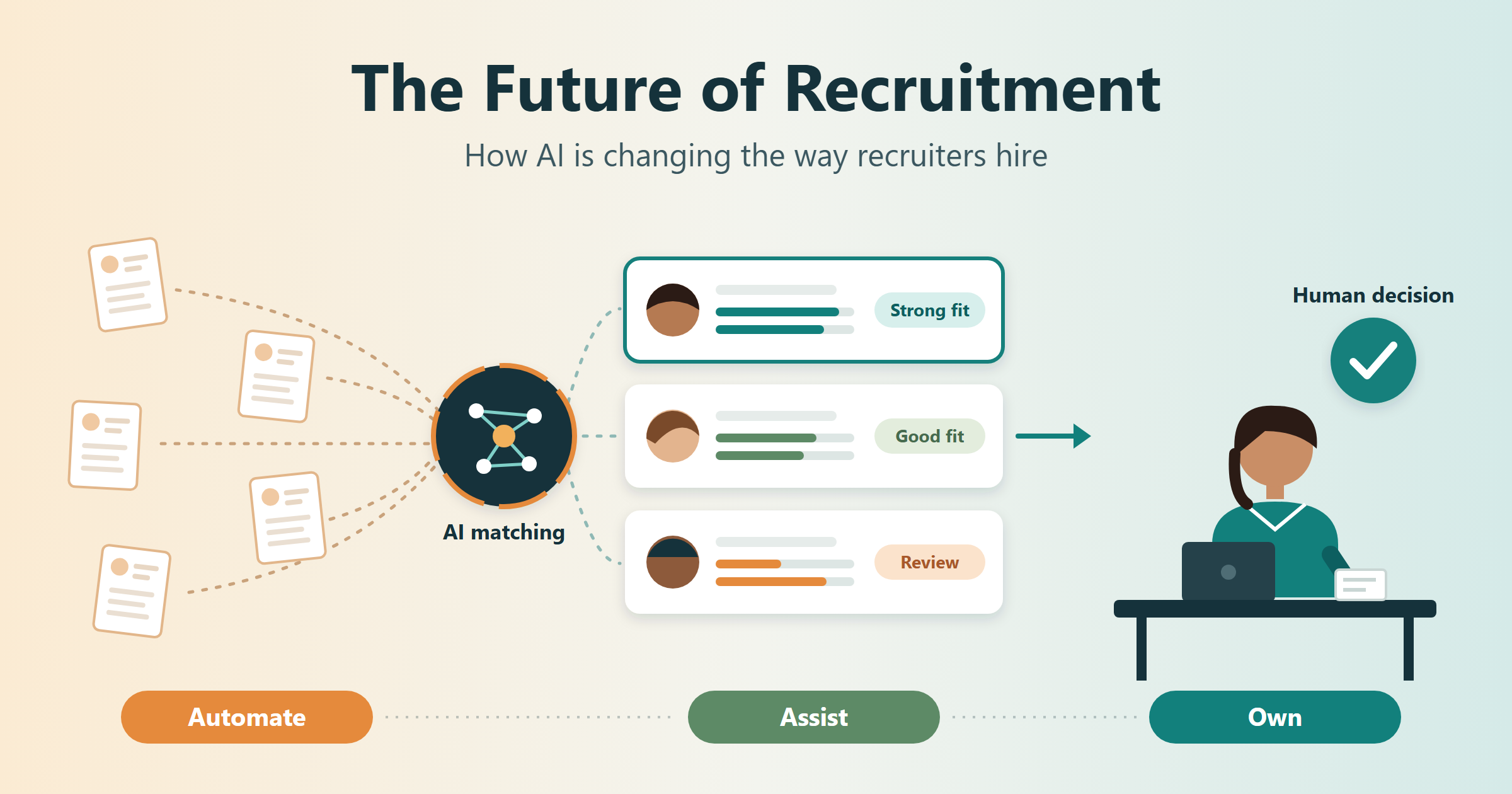
A Practical Model: Automate, Assist, Own
TA leaders can sort recruiting tasks into three categories before adopting AI.
| Category | Definition | Examples |
|---|---|---|
| Automate | Low-risk, repetitive tasks with clear rules | Interview scheduling, application acknowledgments, status updates, FAQ responses |
| Assist | AI recommends, and a person reviews | Résumé matching, candidate rediscovery, interview summaries, assessment scoring |
| Own | People decide and remain accountable | Final selection, rejection of borderline candidates, offer decisions, exceptions |
As a simple rule, the more a decision affects someone's livelihood, the more firmly it belongs in the "own" category.
This model also makes governance easier. It tells candidates, auditors, and your own team where AI is used and where people are responsible.
What AI Should Not Decide
A useful hiring AI is designed with limits. Organizations should be cautious about tools that:
- Reject candidates automatically without human review, especially on narrow criteria.
- Score personality or emotion from video, voice, or facial expressions, where links to job performance are weak and the risk of disadvantaging people is high.
- Rely on proxies for protected characteristics, such as certain postcodes, employment gaps, or graduation years.
- Cannot explain their outputs in terms a recruiter could share with a candidate.
The question to ask a vendor isn't only "How accurate is it?" It is also "How do we know when it's wrong, and what happens then?"
Responsible AI Is Now Part of Recruiting Quality
Bias in hiring didn't begin with AI. Unstructured interviews, inconsistent criteria, and affinity bias have long shaped outcomes. AI can make some of those patterns easier to detect, or repeat them at scale.
What decides which way it goes is governance:
- Job-relevant criteria: Base matching and assessment on skills the role actually requires.
- Regular bias testing: Review selection rates across groups where lawful and appropriate.
- Transparency: Tell candidates when and how AI is used in the process.
- Human review: Make sure trained people review consequential decisions.
- Accessibility: Offer adjustments for candidates with disabilities.
- Auditability: Keep records of criteria, model changes, and decisions.
Regulation is moving in the same direction. The EU AI Act treats AI used in recruitment and selection as high-risk. New York City requires bias audits for certain automated employment decision tools. Requirements vary by jurisdiction and continue to evolve, so legal review belongs in every AI hiring rollout.
How to Measure Whether AI Is Improving Hiring
Time-to-hire matters, but a faster process that produces weaker hires isn't progress. Track a balanced set of measures.
| Area | What to Measure |
|---|---|
| Efficiency | Time-to-shortlist, recruiter hours spent on administration, time-to-offer |
| Quality | Interview-to-offer ratio, hiring manager satisfaction, early performance and retention |
| Fairness | Selection rates across groups at each stage, adverse-impact checks |
| Candidate Experience | Response times, drop-off by stage, candidate feedback |
| Model Health | How often recruiters override recommendations, and why |
The override rate deserves particular attention. Frequent overrides may mean the criteria are wrong. Very rare overrides may mean recruiters have stopped checking.
Skills Recruiters Will Need Next
The recruiters who thrive alongside AI will strengthen five capabilities:
- Skills-based job design: Turning vague requirements into observable skills.
- Data literacy: Reading funnel and assessment data without overinterpreting it.
- Structured interviewing: Gathering comparable evidence across candidates.
- AI judgment: Questioning recommendations and spotting likely errors.
- Advisory influence: Helping hiring managers make better trade-offs.
Each of these depends on human expertise. AI makes them more valuable, not less.
What Comes Next?
Several developments are already taking shape:
- AI agents that handle multi-step tasks: Sourcing, outreach, and scheduling with less manual prompting, under human supervision.
- Skills profiles that travel: Verified skills evidence that follows candidates from assessment to interview to internal mobility.
- Continuous talent intelligence: Hiring data that informs workforce planning, not just reporting.
- Integrity checks: Stronger identity verification as AI-generated applications and interview assistance become more common.
- Explainability as standard: Buyers expecting every recommendation to come with clear reasons.
The common thread is that AI will do more of the work, and organizations will be expected to explain more of the outcomes.
The Recruiter's Advantage
The future of recruitment depends less on how much AI a team uses than on how well its people use it.
Teams that treat AI as a shortcut may hire faster and learn little. Teams that treat it as decision support, with clear limits and active oversight, can improve speed, fairness, and quality of hire together.
PeopleXM is built around that view of hiring: AI that does the heavy lifting and recruiters who make the decisions. Its AI-powered ATS, AI recruiter capabilities, and smart skill assessments are designed to give hiring teams clearer evidence for every decision.
A useful first step: List every task in your hiring process and decide whether it should be automated, assisted, or owned.
Keep reading